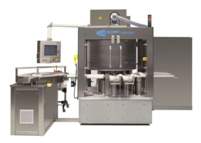
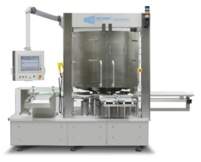
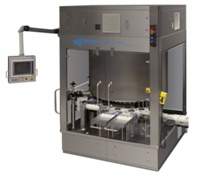
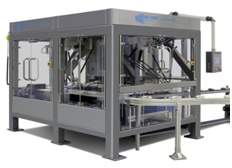
As a manufacturer of in-line, off-line and laboratory machines with non-destructive testing methods, WILCO’s technologies are used to inspect vials, ampoules, prefilled syringes, BFS products, IV bags, blister, pouches trays and any pharmaceutical product that requires a quality declaration.
WILCO’s laboratory machines are suitable for:
- Container closure integrity testing
- X-ray-based particle detection
- Laser-based headspace analysis
- Laser-based gas detection
- NIR-based residual moisture measurement
- Camera-based cosmetic inspection
Liquid-filled container for leak detection
The loss of vacuum inside a test chamber, as a result of either headspace gas leakage or liquid vaporisation from a leak, can be measured by WILCO’s patented liquid-filled container (LFC).
Our LFC technology is suitable for leak detection in:
- Prefilled syringes
- Liquid-filled vials
- Liquid-filled ampoules
- BFS products
- IV bags
Our LFC method is considerably more sensitive to measuring the loss of vacuum than standard pressure decay methods.
This vacuum-based CCI method was also used to manufacture the first ever high-speed leak tester for prefilled syringes, which guarantees no movement within the stopper during the test.
Headspace analyser to detect small gas concentrations
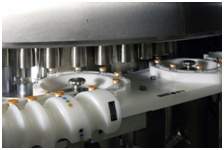
Gas concentrations, such as oxygen or moisture, can be reliably detected using our laser absorption spectroscopy. With an individual laser beam in every testing station and test speeds of up to 600 vials a minute, our headspace analyser rotary machines guide a wavelength modulated, low-power laser beam through the headspace of a parenteral product.
Accurate measurements of the smallest oxygen levels can be detected using our technology and information on the remaining absolute pressure in the headspace can be provided.
Leak sizes smaller than 1 micron can also be reliably detected, allowing for monitoring of the container closure integrity.
X-Ray-based foreign particle detection and component verification
WILCO has manufactured the first ever in-line foreign particle detection system based on low energy X-ray. This new technology can detect both visible and non-visible foreign particulate matters in lyo, suspension and clear liquid formulations.
It can also be used to perform component verifications, such as the detection of non-visible needle damages in prefilled syringes, damages to rubber stoppers or chipped glass rims underneath the aluminium cap on vials or the verification of correctly assembled auto injectors.
Near infrared inspection system
Near infrared (NIR) technology is used in our inspection system to determine the water content in freeze dried produce. WILCO’s NIR-inspection system is a quantitative method that can handle up to 3,000 vials a minute.
The near infrared inspection system is an ideal tool for final quality checking of freeze dried products.
Pressure or vacuum decay methods
The pressure or vacuum decay methods measure the increase or decrease of a differential pressure. The most appropriate method is selected based on the characteristics of the container and the product.
WILCO designs the testing chambers for each type of container, optimising the air volume around the samples; these methods are suitable for vials, ampoules and pouches.
Final quality machine design
Our final quality, combination machine concept offers our customers the option to incorporate all integrated technologies, or to have only selected technologies on the machine platform.The system can be operated in-line or off-line, with tray-in or tray-out material handling options, and each technology can be activated as required.
Force sensor technology
For flexible packaging IV bags, our force sensor technology measures the change of the applied pressure on the bags, in case of a leak. We differentiate between leak sensitivities in the headspace and liquid part.
The in-line leak detection machines, which use our force sensor technology, can work at a speed of 11,000 IV bags an hour.
In combination with our vacuum decay method, we use the force sensor technology for detecting leaks in blisters and pouches.