Radiopharmaceutical therapies are moving from niche innovation to a mainstream oncology option. For supply chains built around stable, mass-produced medicines, radiopharma introduces a new set of constraints. These include short half-lives, strict temperature control, and overlapping pharmaceutical and radiation-safety regulations that can vary considerably by country.
Radiopharmaceuticals: precise targeting of cancer cells
Radiopharmaceuticals combine a pharmaceutical targeting molecule with a radioactive isotope. The targeting component delivers radiation directly to cancer cells, aiming to destroy tumors while limiting damage to healthy tissue. This precision approach means fewer side effects and better quality of life than more invasive or broadly acting treatments.
This potential is no longer theoretical or small-scale. Breakthrough approvals and growing clinical pipelines are expanding the range of cancers that can potentially be treated. Marco Hogenboom, Senior Director of Personalized Supply Chain at World Courier, a Cencora company, explains that the sector’s visible acceleration is more recent than many assume. “In less than a decade, the radiopharma sector has shifted into top gear,” he says.
Beyond a few flagship therapies, the pipeline is what’s driving long-term momentum. Advances in radioisotope production, manufacturing capabilities, and scientific innovation are converging with a sharp rise in clinical trials. Market forecasts reflect that growth trajectory, with one recent report by GlobalData projecting that global radioligand therapy sales surpassed $2 billion in 2024 and will reach over $10.5 billion by 2031, with a compound annual growth rate of 25.6%.[i] Meanwhile, the volume of new radiopharma clinical trials has increased 133% between 2022 and 2025 — and in the first four months of 2026 alone, there are already 25% more new trials recorded than across the whole of 2022.[ii]
Importantly, radiopharma is also expanding beyond initial indications. Hogenboom adds that that early applications — such as prostate cancer — are now giving way to broader exploration in solid tumors. “From there on, it’s been developed into more solid tumors, say brain tumors, breast cancer,” he says. “So, there are more opportunities to cure types of cancer that have been addressed differently in the past.”
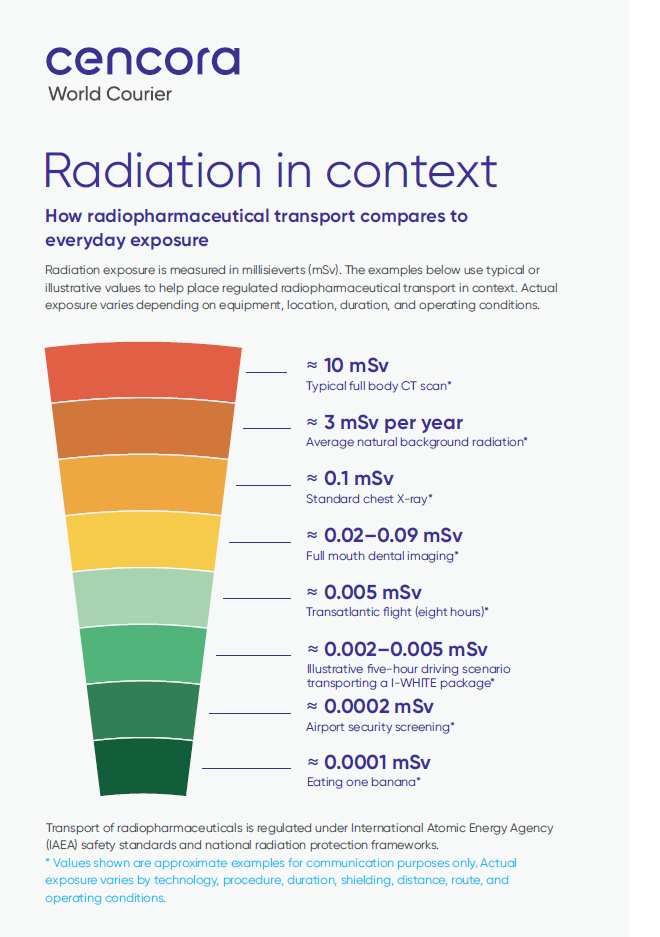
At the same time, radiopharma still faces a perception hurdle. “For many, radiopharma is still a bit abstract,” says Hogenboom, adding that radiation is sometimes viewed unfavorably by the public. Yet radiation exposure is part of daily life and in controlled medical and transport contexts, it is carefully regulated. As Hogenboom relays, Cencora’s internal experts often remind audiences that an everyday activity can exceed the exposure associated with a therapy shipment. “From the flight I had from Brussels into the US, I get more radioactivity than what you would get from transporting a therapy like that,” he adds.
Why radiopharma logistics is uniquely complex
Radioactive decay begins as soon as the product is made. Hogenboom summarizes the operational reality: “From the moment the isotope has been manufactured and married up with the pharmaceutical ingredient, you have three to ten days, within which time the patient has to be infused with the therapy.”
While shipping isotopes alone may not require temperature management, the moment they are combined with a drug component, temperature control becomes the norm. “In 99% of the cases, there’s a temperature control requirement,” Hogenboom says — commonly 2°C – 8°C, but sometimes “minus 80, minus 20, or even controlled room temperature.” Packaging must therefore do two jobs at once. It must protect the product thermally and shield radiation to safeguard personnel, often using specialized Type A packaging under strict standards.
Radiopharmaceuticals sit at the intersection of pharmaceutical regulation and radiation safety rules. The result is a compliance landscape that is both strict and unevenly applied. Hogenboom describes just how fragmented requirements can be, even within a single region such as the EU. Some countries require comparatively simple measures, while others introduce layers of licensing, audits, and worker monitoring.
“Germany or Australia have very rigid regulatory requirements with regards to licenses,” he adds, noting that drivers may need dosimeters to record exposure. In Australia, requirements can even vary from state to state.
Meeting logistics demands for radiopharma products
Radiopharma sponsors increasingly look for partners who can orchestrate time-critical, temperature-controlled, heavily regulated shipments with proactive monitoring and disciplined deviation management. “There’s a very rigid orchestration required,” says Hogenboom, adding that this spans manufacturing readiness, routing, customs knowledge, and alignment with clinical schedules.
World Courier’s approach is built for that level of precision. As the specialty logistics provider within Cencora, the company offers GDP/GxP-compliant processes, Class 7 Dangerous Goods expertise, real-time tracking, and 24/7 exception management, delivered through a global network of more than 120 facilities over 50 countries.
But World Courier’s differentiator is structural as well as operational. Hogenboom highlights that many market offerings rely on a patchwork of third parties. “Often you see a knitting work of subcontractors… people who do the last mile, first mile, etc.,” he says. By contrast, he adds: “World Courier is setting this up entirely within our company. So, it’s not like we operate like a control tower and we have partner X doing the Nordics and partner Y taking care of Germany.”
That fully in-house model supports consistent handling standards and a stronger chain of custody — reducing the risk that, in an exception, a partner optimizes for its own priorities rather than the patient’s delivery window. As Hogenboom puts it, subcontractors may first think about “their own scope of work”, whereas an owned-network approach can provide tighter end-to-end controls.
Radiopharma handling services
One of the most persistent barriers is the misconception that radiopharma is inherently dangerous to handle. Hogenboom argues that, with standard operating procedures, it can be safer than many familiar cold-chain hazards. “It’s less dangerous if you deal with it correctly than when you work with cryogenic temperatures or with dry ice,” he adds.
World Courier’s “radiation in context” materials help reset that perspective by comparing regulated transport exposure with everyday sources, such as flights, medical imaging, and even eating a banana. The message is not that radiopharmaceuticals are casual cargo, but that they are tightly controlled and safe when handled correctly, under IAEA standards and national radiation protection frameworks. Radiopharma is reshaping cancer care, and it’s transforming logistics in parallel. As therapies become more patient-specific, time-sensitive, and globally distributed, the most effective processes will be in supply chains built for precision. World Courier is investing now to ensure these life-changing therapies arrive “on time, on temperature, and fully compliant,” says Hogenboom.
To learn more about how radiopharmaceutical therapies are becoming a mainstream oncology option, download the document below.
[i] GlobalData, Radiopharmaceuticals Market Overview. January 2026.
[ii] GlobalData Pharmaceutical Intelligence Center, Clinical Trials database. Accessed 29th April 2026.