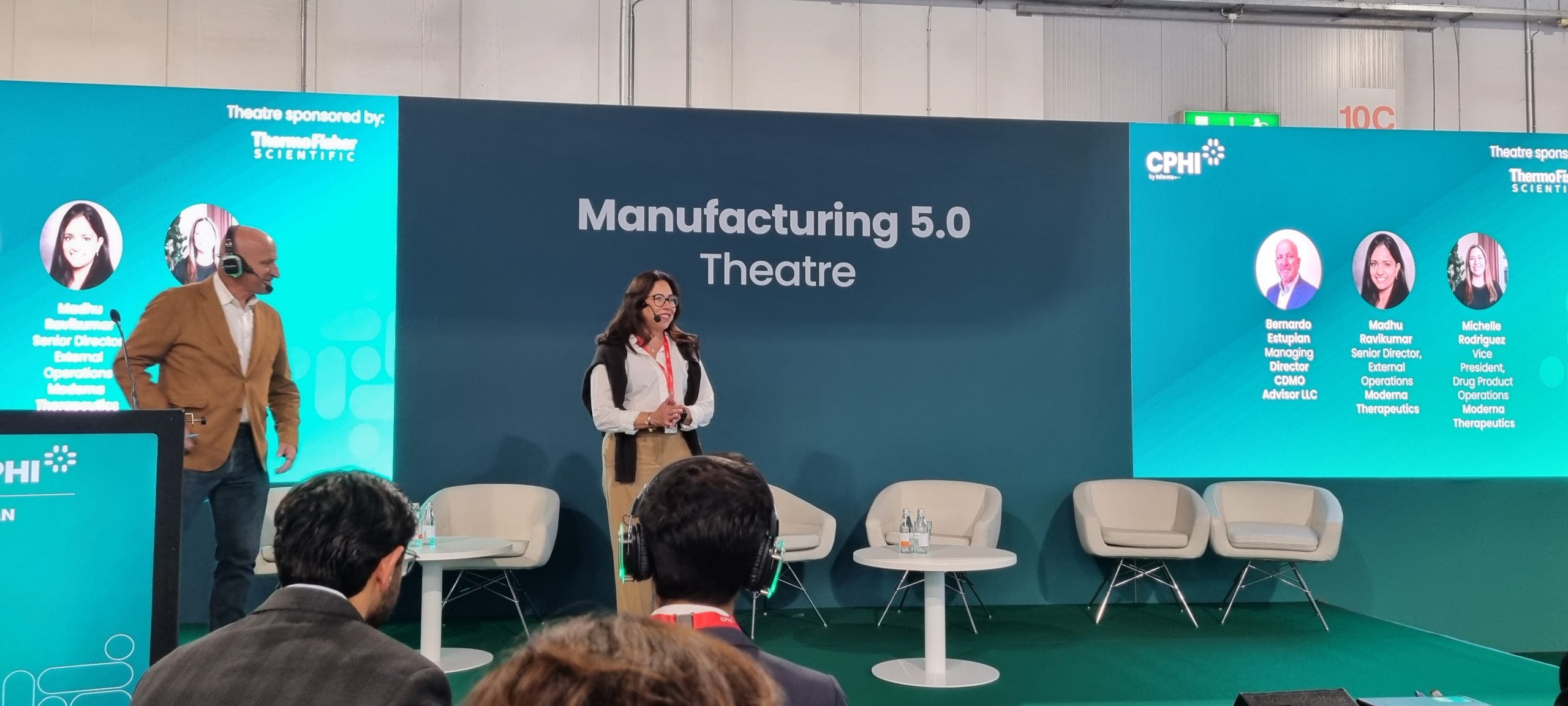
Moderna Therapeutics is well acquainted with managing evolution, so perhaps it’s no surprise that the firm’s vice president of drug product operations, Michelle Rodriguez, kept returning to the theme during her presentation at CPHI Milan 2026.

She took the stage at the outsourcing event, which is taking place 6-8 October at Fiera Milano, to discuss building manufacturing capabilities for next-generation medicines at a time when Moderna is looking to its own next-generation of messenger RNA (mRNA) therapeutics and vaccines.

The Cambridge, Massachusetts-based biotech previously had stellar success with its mRNA Covid-19 vaccine Spikevax (elasomeran). First approved in 2021, Spikevax was transformational for the company, achieving sales of $17.7bn and $18.4bn in 2021 and 2022 respectively.

However, sales predictably declined as the pandemic waned and Moderna’s entire 2025 revenue fell 40% year-on-year to $1.9bn. The company’s Covid vaccines accounted for the lion’s share of that total, which though far from the product’s high point is still a not inconsequential amount.

“A lot of people feel that Covid-19 as a topic has gone away, but there’s still that need and also mRNA has gone into a lot of other things,” Rodriguez told the CPHI Milan audience.

For Moderna those things include its Respiratory Syncytial Virus (RSV) vaccine mRESVIA, first approved in the US and Europe in 2024, and the influenza vaccine Mflusiva, which won US and European approvals in 2026. The company is also developing the cancer treatment intismeran autogene in partnership with Merck & Co in a range of tumour types that include melanoma, non-small cell lung cancer, bladder cancer and renal cell carcinoma.

It remains to be seen how the US government will approach new drugs like intismeran autogene, after cutting federal funding for more than 20 mRNA vaccine projects in 2025, but on the broader question of how regulators are managing the needs of modern medicines Rodriguez said things are moving in a positive direction.

“[The] regulatory aspect has evolved, [there’s] openness to treating mRNA as a platform,” she said, adding that, where previously applications were difficult and time consuming, now the view is to reduce complexity, acknowledge platform manufacturing and take advantage of that. “I’ve seen a lot of flexibility [from regulators].”

When it comes to manufacturing Modera’s next generation of medicines, the company will be able to build on its pandemic-era experiences. These saw it go through a period of rapid change management under highly pressurized conditions as it built-out manufacturing capacity.

Covid meant the company “had to evolve to include contract manufacturing, and that continues today”, Rodriguez explained at CPHI Milan. A key part of this, she said, was deciding what manufacturing elements to keep in-house and what to outsource to contract development and manufacturing organizations (CDMOs).

Partners for the company’s Spikevax Omicron XBB.1.5 version of its Covid vaccine variously include Novo, Astrea Pharma, Rovi Pharma Industrial Services and MCS Laboratories across API, dosage, and packaging services, according to GlobalData’s Drugs By Manufacturer database.

Amid the rise in its use of outsourced manufacturing capabilities, Moderna chose to keep drug substance manufacturing “fully internal”. It’s about “protecting what we need to supply” as well as working with CDMO partners, Rodriguez said.

Those partnerships are an area that Rodriguez said has evolved further since the pandemic, and Moderna has worked with a number of companies for producing drug product and has some drug substance partnerships in countries where it doesn’t make sense to manufacturing internally.

At the same time the firm has expanded its international network of advanced manufacturing centres, last year adding a UK facility to existing locations in Canada and Australia. “Strategies as well as medicines have evolved considerably,” she concluded.