
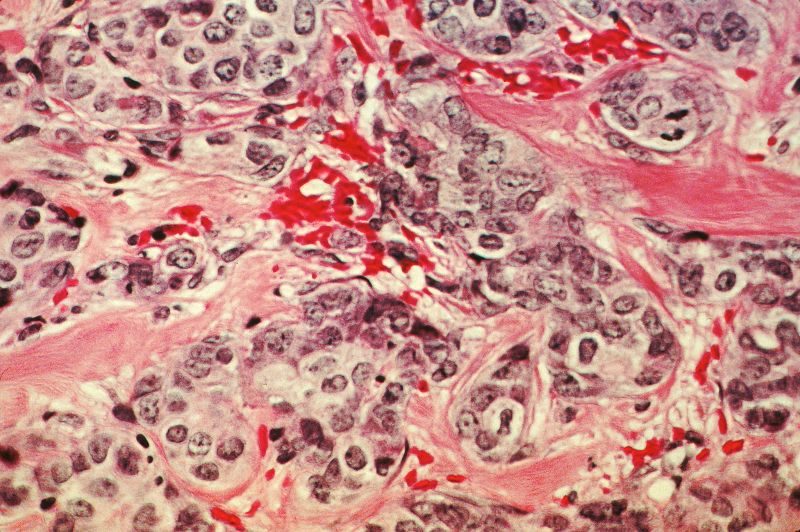
A study by researchers at The Institute of Cancer Research, London (ICR), has revealed that a drug, BOS172722, could help boost chemotherapy response in aggressive breast cancers that have become resistant.
Discovered at the ICR’s Cancer Research UK Cancer Therapeutics Unit, BOS172722 is designed to force cancer cells to rapidly divide, thereby causing fatal errors in DNA parcelling, leading to cell death.
Go deeper with GlobalData


Discover B2B Marketing That Performs
Combine business intelligence and editorial excellence to reach engaged professionals across 36 leading media platforms.
The drug inhibits the MPS1 molecule, which regulates cell division. Testing has taken place in cells grown in the lab, as well as in mice.
Cancer cells grown in dishes and treated with BOS172722 were observed to undergo cell division within 11 minutes versus 52 minutes without the drug.
Researchers observed that fast-growing cancers, including triple-negative breast, ovarian and lung cancers, were particularly sensitive to the effects of blocking MPS1.
Commonly, triple-negative breast cancer is treated using taxane chemotherapies, such as paclitaxel, which also works on cell division. However, some cancer cells escape the therapy and become resistant to the drug, noted the researchers.

US Tariffs are shifting - will you react or anticipate?
Don’t let policy changes catch you off guard. Stay proactive with real-time data and expert analysis.
By GlobalDataWhen the team evaluated paclitaxel and BOS172722 combination, cell division time was found to decrease from 110 minutes with paclitaxel alone to 15 minutes with the combination.
Moreover, all cells treated with the combination died, while 40% of those treated with paclitaxel alone remained alive.
In mice, low doses of the MPS1 inhibitor plus paclitaxel was found to be effective. BOS172722 was also well-tolerated in the animals at the doses that almost destroyed the tumours.
ICR cancer biology and therapeutics professor Spiros Linardopoulos said: “We have discovered a brand new type of cancer treatment that uses cancer’s rapid growth against it, by forcing cells through cell division so quickly that they accumulate fatal errors.
“Crucially, the combination is anticipated to be effective in cancer patients that have already become resistant to chemotherapy alone and has the potential to become a much-needed extra treatment option that could extend the lives of patients.”
The drug is currently undergoing a clinical trial for the treatment of solid tumours, including aggressive triple-negative breast cancers.


