

Roche’s Actemra / RoActemra (tocilizumab) has received approval from the European Commission (EC) to treat giant cell arteritis (GCA).
Go deeper with GlobalData


Discover B2B Marketing That Performs
Combine business intelligence and editorial excellence to reach engaged professionals across 36 leading media platforms.
Also known as temporal arteritis (TA), GCA is a chronic and potentially life-threatening autoimmune condition, which if left untreated, can cause blindness, aortic aneurysm or stroke.
Roche chief medical officer and product development global head Dr Sandra Horning said: “In GCA, the blood vessels in the head and neck, as well as the aorta, become inflamed and thickened, reducing blood flow.
“This can result in devastating symptoms, including irreversible blindness, and puts patients at risk of permanent organ damage.”
Tocilizumab is the first approved anti-IL-6 receptor biologic available in both intravenous (IV) and subcutaneous (SC) formulations to treat adult patients with moderate-to-severe active rheumatoid arthritis (RA).
It is also the first therapy currently approved for the treatment of GCA in Europe.
Horning added: “We are delighted that Actemra / RoActemra has been approved for the treatment of GCA in Europe. As the first effective non-steroid therapy for GCA, Actemra / RoActemra has the potential to fundamentally change how this condition is treated.”
The EC approval is based on the results from the global, randomised, double-blind, placebo-controlled Phase III GiACTA trial.
The trial demonstrated that a weekly dose of tocilizumab, initially combined with a six-month steroid taper, can significantly increase the proportion of patients attaining sustained remission at one year compared to a six-month steroid taper administered alone.
The multicentre study involved 251 patients from 76 sites across 14 countries and was the first to use blinded, variable-dose, variable-duration steroid regimens.
In addition, Roche received EC approval for Gazyvaro (obinutuzumab) in combination with chemotherapy, followed by Gazyvaro maintenance in people achieving a response, as a new treatment option for previously untreated advanced follicular lymphoma.
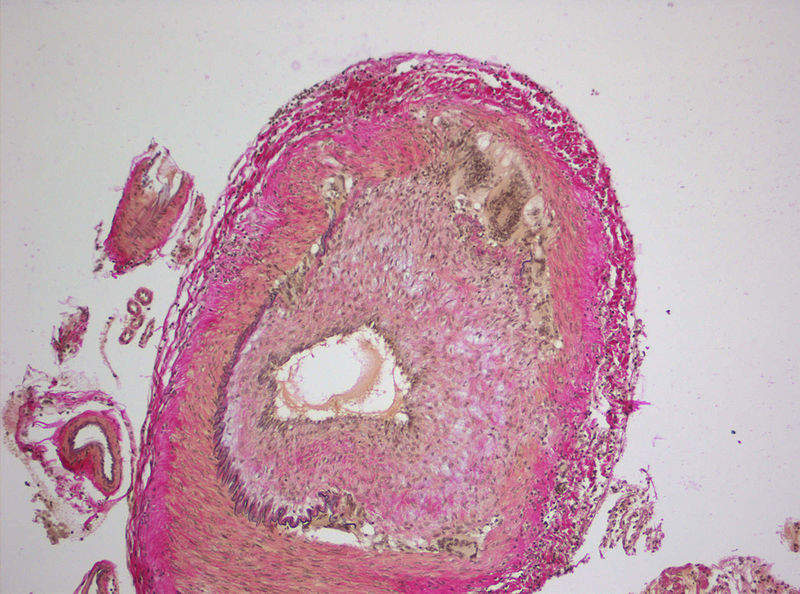
Image: Histopathology of giant cell vasculitis in a cerebral artery. Photo: courtesy of Marvin 101 via Wikipedia.


