
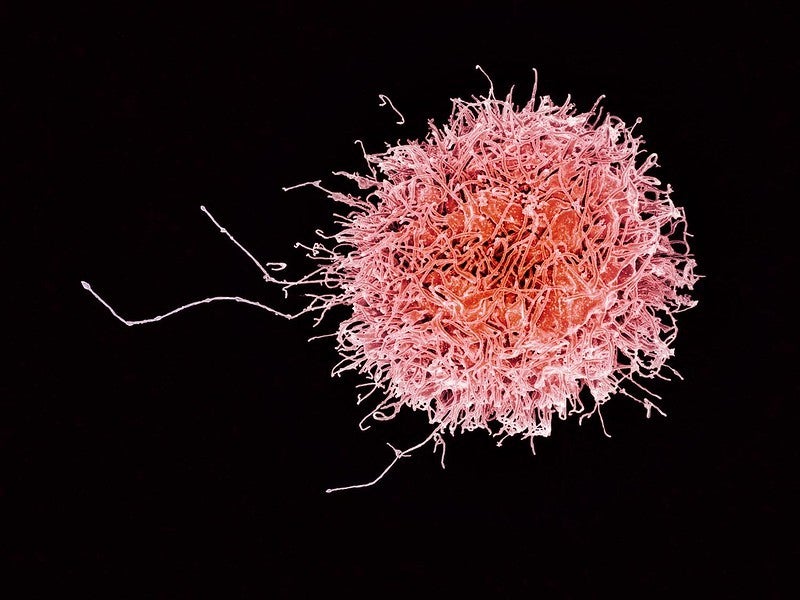
A study led by researchers at the MD Anderson Cancer Centre has shown that Natural Killer (NK) cells that have been modified to express an anti-CD19 chimeric antigen receptor (CAR) are effective in two blood cancers and was not associated with toxic effects often caused by CAR-T therapy.
In a study of 11 people with relapsed or refractory CD10-positive cancers non-Hodgkin’s lymphoma or chronic lymphocytic leukaemia, the CAR-NK cells did not cause “the development of cytokine release syndrome, neurotoxicity, or graft-versus-host disease”.
Go deeper with GlobalData


Discover B2B Marketing That Performs
Combine business intelligence and editorial excellence to reach engaged professionals across 36 leading media platforms.
There was also “no increase in the levels of inflammatory cytokines, including interleukin-6, over baseline”.
In terms of efficacy, 73% of the 11 patients treated had a response and seven had complete remission. These results were seen within 30 days after infusion and CAR-NK cells expanded and persisted for at least 12 months.
Another benefit of CAR-NK therapy over CAR-T therapy demonstrated in this study is improved manufacturing processes. NK cells are allogeneic so they can be derived from a healthy donor, rather than the patient themselves. This means they could be manufactured in advance and stored for future off-the-shelf use.
The NK cells were derived from umbilical cord blood, then transduced with a retroviral vector to express the anti-CD19 CAR, inteuleukin-15 and inducible caspase 9.
The technology platform used by MD Anderson Cancer Centre has been licensed to Takeda, and as part of the related agreement, the Japanese pharma company will have exclusive rights to develop and commercialise up to four CAR-NK programmes, including the anti-CD19 CAR-NK cell therapy (TAK-007).
MD Anderson will collaborate with Takeda on the pivotal clinical trial for TAK-007 in 20021. MD Anderson Cancer Centre professor of stem cell transplantation and cellular therapy Katy Rezvani said: “We are encouraged by the results of the clinical trial, which will launch further clinical studies to investigate allogeneic cord blood-derived CAR NK cells as a potential treatment option for patients in need.
“We look forward to building upon these results in larger multi-centre trials as we work with Takeda to make this therapy available more broadly.”
The results of this early stage study were published in the New England Journal of Medicine, and the work was funded by the MD Anderson Cancer Centre, Lymphoma and the US National Institutes of Health.


