
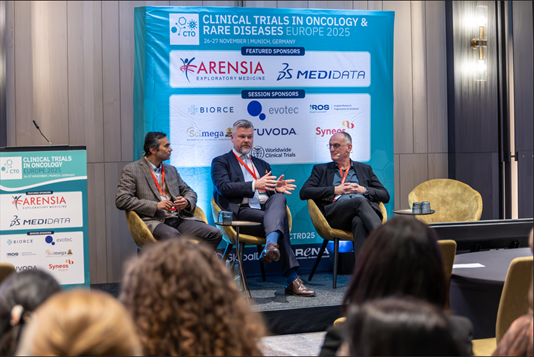
As the standard of care (SoC) for new drugs in oncology continues to improve, trials need to be designed with precision medicine in mind.
Experts at a recent conference in Munich said that study recruitment and selection of the wrong inclusion and exclusion criteria is a common downfall that leads to study failure. They argued that appropriate biomarkers should be utilised to select relevant patient cohorts, rather than chasing an approval in the broadest indication to maximise market potential, as has been seen in the past.
Go deeper with GlobalData

Discover B2B Marketing That Performs
Combine business intelligence and editorial excellence to reach engaged professionals across 36 leading media platforms.
Experts made these statements at the Clinical Trials in Oncology (CTO) Europe 2025 meeting, which took place on 26–27 November.
While this approach may have worked previously, Guido Wuerth, head of corporate development, radiopharmaceuticals at Sweden-based Affibody, argued that as the SoC evolves and improves, the threshold for clinical trial and commercial success continues to rise.
Separately, panellists also said that it’s important to design trials in close collaboration with patient organisations to understand which elements of the trial resonate well with patients and which may be burdensome.
“You need to conceptualise the patient profile,” said Dariusz Adamczewski, managing director at nonprofit Children’s Tumor Foundation Europe.
Pathios Therapeutics’s chief medical officer Sumeet Ambarkhane said: “Not every patient can benefit from every drug, and it’s such an important thing to identify the parameters that differentiate responders versus non-responders.”
Outside of biomarkers and targeted recruitment based on a patient’s likelihood to respond to a treatment, Adamczewski cautioned that it’s important to ensure participant criteria are not overly restrictive.
He said: “To avoid failure in the recruitment phase, you also need to precisely design all the inclusion criteria.” He added, as an example, that criteria should not be overly restrictive and unnecessarily exclude patients who have been previously treated or have some comorbidities.
Recruitment in the age of AI
In a later talk at the conference, Sandoz’s global clinical development manager Eslam Katab spoke on how AI-augmented tools can be utilised to streamline and enhance the process of participant selection and screening in clinical trials.
For example, the open-source tool TrialMatchAI provides end-to-end patient matching. According to Katab, the system can process both structured and unstructured patient data and review this against all eligibility criteria to determine whether a patient qualifies for the trial and provide an explanation as to why. He added that the system can pre-screen 1,000 patients in hours compared to the days or weeks it may take to complete the checks manually.


