
Unlocking Cell Surface Protein Research with Site-Specific Labelling
Applications in Flow Cytometry, Cell Sorting, Target Validation, and Therapeutic Discovery
Introduction
Cell surface proteins are essential regulators of cell communication, mediating immune activation, cell adhesion, receptor signalling, and tissue homeostasis. Many cell surface proteins, including immune checkpoints, co-stimulatory receptors, tumour-associated antigens, and lineage markers, have become critical therapeutic targets and biomarkers in cancer, autoimmune diseases, and other immune disorders. Their central roles in both physiology and disease have driven the rapid development of precision therapeutics and increased demand for robust tools for target characterisation and translational research.

Characterisation of these cell surface targets often involves sensitive detection, binding assays, and cell-based assays, where labelled recombinant proteins are widely used to enable reliable and reproducible analysis. Site-specific labelling enables conjugation at defined amino acid sites with precise control over labelling position and stoichiometry, helping preserve native protein conformation and biological activity.
To support research on cell surface targets, Sino Biological offers high-quality, site-specifically labelled recombinant proteins that preserve native conformation and biological activity while providing high stability and batch-to-batch consistency for applications in flow cytometry, cell sorting, target validation, and therapeutic antibody discovery.
Physiological and pathological roles of cell surface proteins
Cell surface proteins function through specific interactions with ligands, receptors, and antibodies to regulate immune responses, cell adhesion, signal transduction, and tissue homeostasis. These interactions coordinate diverse physiological processes and ensure accurate communication between cells.
Dysregulated expression, aberrant signalling, or disrupted molecular interactions can contribute to the development of cancer, autoimmune diseases, inflammatory disorders, and infectious diseases. Because these biological activities depend on precise molecular recognition and native protein conformation, maintaining native protein structure and function is essential for accurately studying cell surface proteins and their interactions.
Cell surface proteins in therapeutic development
The rapid expansion of therapies targeting cell surface proteins has transformed these molecules from fundamental biological regulators into one of the largest classes of therapeutic targets. Immune checkpoint proteins such as PD-1 and B7-H3, co-stimulatory receptors including CD28 and 4-1BB, as well as tumour-associated antigens such as CD19, BCMA, CD38, and GUCY2C, are now widely exploited for the development of monoclonal antibodies, bispecific antibodies, antibody–drug conjugates (ADCs), and CAR-T cell therapies.
In parallel, adhesion molecules including NCAM1 and Cadherin-17 have emerged as promising biomarkers and therapeutic targets in cancer and other diseases. As these therapeutic modalities continue to diversify, accurate characterisation of target expression, receptor occupancy, ligand binding, and antibody specificity has become increasingly important throughout drug discovery and development. These growing demands have driven the need for high-quality recombinant proteins that faithfully preserve native structure and biological function, providing reliable tools for translational research and therapeutic development.
Site-specific labelling for cell surface protein research
Cell surface proteins mediate highly specific molecular interactions, including receptor–ligand binding, antigen–antibody recognition, and protein–protein interactions. Because these functions depend on native conformation and intact binding sites, recombinant proteins used in cell-based assays must retain their biological activity after labelling.
Fluorescent dyes, biotin, and other labels are commonly introduced to support applications such as flow cytometry, CAR-expressing cell detection, receptor–ligand binding analysis, target validation, and therapeutic antibody characterisation. However, conventional labelling can introduce heterogeneity or interfere with functional regions, potentially affecting binding activity and assay performance.
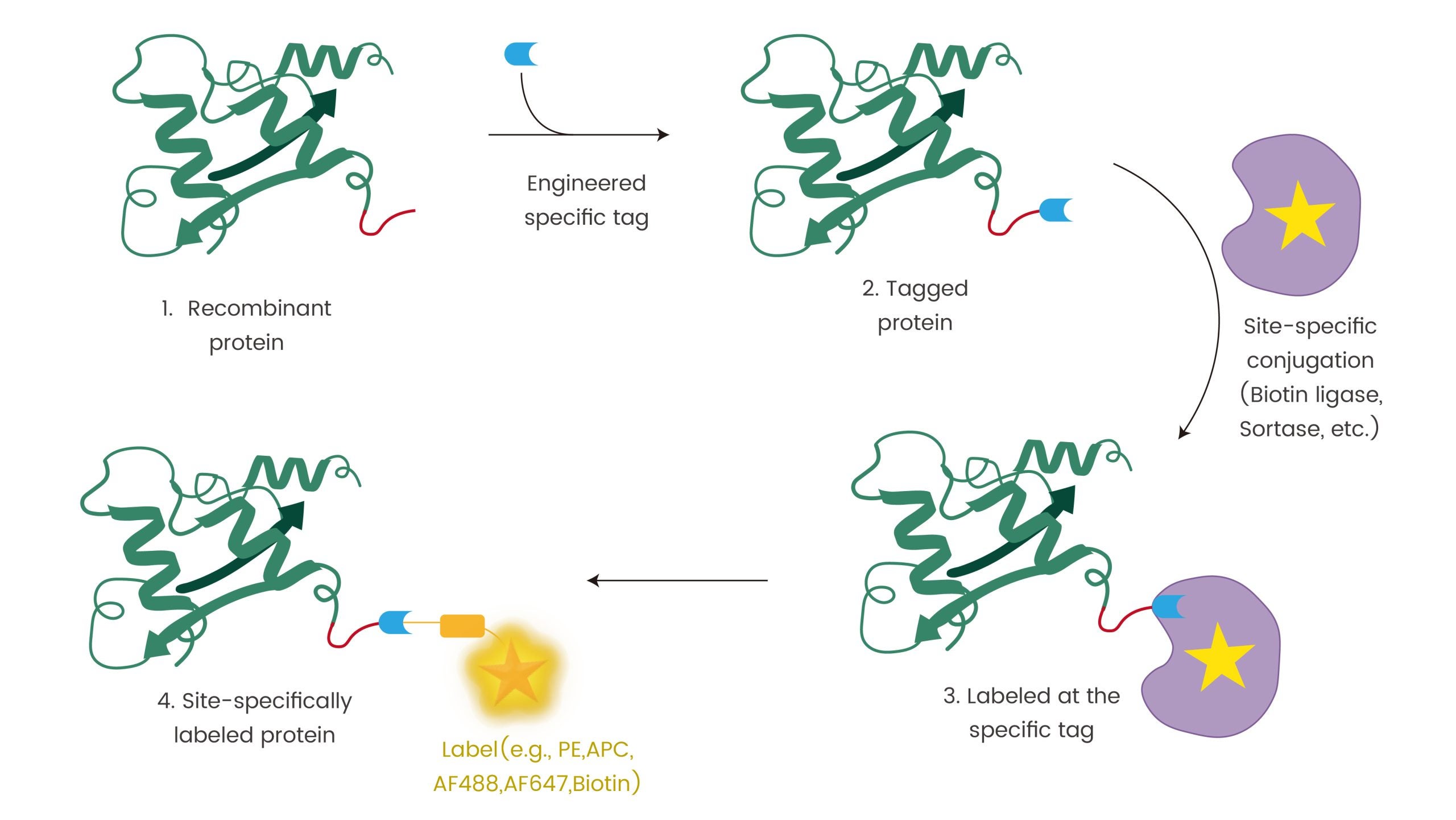
Site-specific labelling addresses these challenges by enabling controlled conjugation at defined amino acid sites and precise labelling stoichiometry. Recombinant proteins are engineered with a defined labelling tag positioned away from functional binding sites. Site-specific conjugation enables attachment of a detection label at a single predetermined site while preserving native protein conformation and biological activity. Compared with conventional random chemical labelling, this strategy minimises interference with ligand- or antibody-binding epitopes, improves batch-to-batch consistency, and supports reliable applications in flow cytometry, cell sorting, target validation, and therapeutic antibody discovery.