
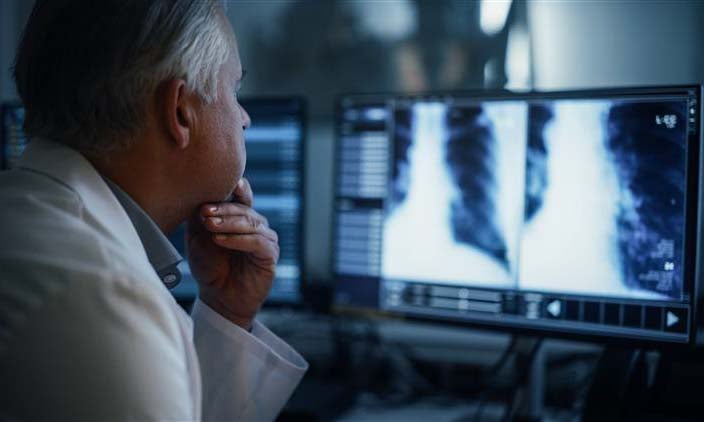
The global shortage of radiologists is having a serious impact on diagnostics and delaying medical treatments, but AI tools for medical imaging in Scotland are now providing solutions.
Radiology is an essential tool in diagnostics by providing images of the body for analysis using CT scans, MRI or X-rays. From the images, it is possible to confirm issues such as early-stage tumours, disease progression, and how effective a treatment is proving for a patient.
However, the shortage of radiologists means patients face delays in diagnoses, and vital opportunities for early interventions could be missed. There is a need to streamline processes because of the greater number of patients awaiting appointments and the limitation of radiologists.
“We need to increase the efficiency of the diagnostic process. Ideally, what we’d like to do is shrink the overall time taken and reduce the amount of human effort required to get to a final diagnosis,” says Dr Ken Sutherland, president of Canon Medical Research Europe, based in Edinburgh.
AI imaging technology being developed in Scotland is making a difference in streamlining processes, which could transform diagnostics around the world.
AI uses in radiology in Scotland
The radiology process begins with patients being scanned, the acquired image is reviewed, and sometimes manipulated in 3D, with the findings written up in a report for the diagnosis and possible treatment recommendations. Understanding the most effective points where AI can be used is helping to deliver value from the technology.
The radiology process can be disjointed, involving a few different companies, agencies, and algorithms. In addition, the process can take weeks. In instances where time is of the essence, any delays can seriously impact the long-term health of patients. However, advances in AI could see the radiology timeline shorten to a matter of hours.
There are various points in the process where data is used and interpreted. And where there is data, there are opportunities for AI. Canon Medical uses a type of AI-based technology called Automated Landmark Detection. When the patient has a CT scan, a low-resolution image is taken. This image is analysed to identify any areas that require closer inspection. Historically, this decision was made manually. Using AI, Canon Medical performs automated scan planning to refine the areas that require further attention.
While refining images itself is not a lengthy manual process, it still consumes the radiographer’s time.
“If you just automate that one little step, you’ve saved them a small amount of time. It’s maybe only seconds, but if they’re doing it 100 times, then that all adds up,” adds Sutherland.
Canon is also using automated exposure for imaging and producing three-dimensional representations of the data as efficiently as possible.
Traditionally, there have been challenges in building hi-res 3D models using CT scans and X-rays due to the amount of radiation exposure for patients. Yet reducing the amount of radiation exposure makes images more difficult to view.
Canon Medical is using technology to improve the clarity and reconstruction of images from scans. This technology was developed in the US and is now being applied to scanners in Scottish hospitals.
Supporting radiologists with AI
AI can also be used to support interpreting images. In Scotland, technology from companies such as Annalise can automatically identify areas of interest in images to support radiologists with diagnostics and decrease the time for manual inspections. Patients who require more urgent attention can be prioritised.
“Generally, these tools have been applied to the triage process to make sure that the right people are being viewed by the radiologist, and the images that are aren’t showing anything significant are just removed from that pipeline,” adds Sutherland.
There are also opportunities for AI to support writing the reports. While large language models (LLMs) are widely used, they often lack specificity when applied in certain industries.
At the current maturity of the technology, there is a danger of embracing LLMs and trusting them fully.
“Making them accurate is still a challenge because AI still has what they call a ‘hallucination problem’, where it states things confidently and in good prose. But in fact, they’re not true,” says Sutherland. “So, that’s a real issue here.”
While use cases are still developing, AI is already making a difference for radiologists.
Freeing up capacity for radiology teams with automation
Automation can free up radiology teams to focus on areas with the greatest clinical value by eliminating manual bottlenecks, standardising processes, and automating repetitive tasks such as triage, routing, and quality assurance (QA ) checks. Automation can reduce variation and errors, accelerate diagnoses, and ensure studies flow seamlessly through healthcare IT systems.
For patients, these benefits can mean shorter waits, fewer delays, and a smoother experience. While departments gain real-time insights to optimise throughput and capacity. At a time when the health services around the world face mounting pressures, these advantages are essential.
“Clinicians and patients alike benefit from automating radiology workflows,” says James Holroyd, managing director of Blackford Analysis, an Edinburgh-based provider of AI solutions for clinical use. “Clinicians are able to spend more time directly with patients and can stay focused on more complex work, while patients receive more timely care and follow-up.”
Blackford’s vendor-neutral AI platform is a collaborative engine, enabling global AI developers to bring their solutions into clinical practice through a single integration, while supporting hospitals in safely evaluating and adopting those tools.
Increasing efficiencies in radiology workflows
AI tools are creating life-changing efficiencies in a range of areas, including acute stroke pathways. Detection tools can flag subtle large-vessel occlusions within minutes. In a case in Germany, early alerts accelerated escalation to thrombectomy and contributed to a full clinical recovery.
There are also AI solutions in use at A&E departments and fracture clinics, clearing negative findings immediately without the need for a radiologist to review. This has saved an estimated 400 hours of patient waiting time at a UK university hospital and helped to ease pressure on clinical teams.
Blackford products are delivering similar value. The company highlights a hospital system in Norway using its products, where AI triage has helped radiologists rapidly clear more than 8,500 negative cases. The result is a reduction in wait times by 250 days.
“We’re already seeing clear, measurable impact from AI across a variety of radiology workflows,” adds Holroyd. “The most consistent gains come from tools that streamline everyday tasks – prioritising urgent cases faster, reducing reporting time, ensuring necessary follow-ups, improving scanner utilisation, and helping teams manage rising volumes without additional staffing.”
The advantages of developing AI for medical imaging in Scotland
Scotland provides a strong base to develop AI in medical imaging because of its vibrant ecosystem, which includes leading companies such as Annalise, Optos, and Canon Medical Research, along with a publicly funded health service, world-class imaging centres such as the Imaging Centre of Excellence in Glasgow and innovative initiatives that include the Data Lab. This provides access to a mature environment where companies such as Blackford can develop, test, and deploy innovative products directly with clinicians, but also through existing networks developed by other Scottish-based companies.
Another advantage in Scotland for AI in healthcare is the linking of patient data. The Community Health Index (CHI) numbers are unique identifiers for patients across the NHS in Scotland. The country also has extensive datasets and research on medical conditions, dating back decades.
In addition, there is a strong pipeline of AI and data-science talent, government support for digital health innovation, and a culture of close collaboration between academia, industry and the NHS. This all provides an optimum environment in Scotland for companies such as Blackford and Canon Medical to accelerate the development of safe, clinically impactful medical imaging AI worldwide.
“It’s not just going to be companies that change this market, it’s got to be a collaboration between ourselves and academics and clinicians,” says Sutherland.
Blackford’s long-lasting collaboration with Optos is a prime example of successful partnerships between two Scottish-based companies, accelerating the commercialisation of an AI platform while providing early access to AI solutions for a leading provider of ophthalmologic solutions.
“Radiology teams are under immense pressure, and AI has a critical role to play in creating sustainable, efficient workflows,” adds Holroyd. “Scotland’s strength lies not just in its talent, but in the willingness of clinicians, technologists, and industry to work together on solutions that make a real difference.”
To learn more about the health ecosystem in Scotland the focus on sustainability, download the document below.