

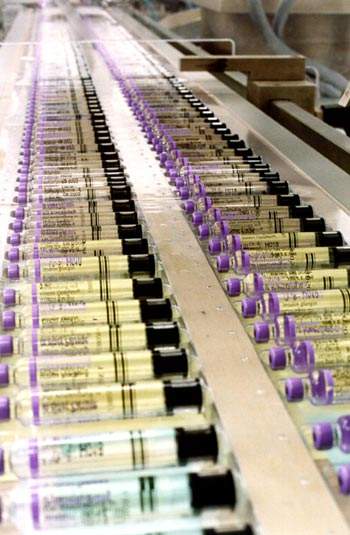
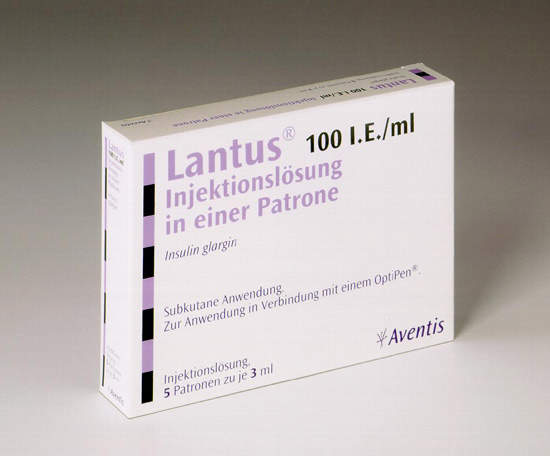
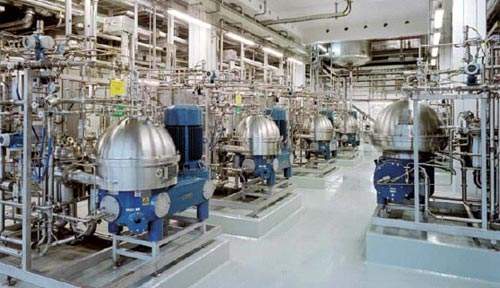
Aventis Pharma completed the construction of its third insulin plant in Frankfurt, Germany, in early 2003. The plant produces around 1,700kg of insulin glargine each year, which is sold in the German, UK and US markets under the trade name Lantus.
The construction of the €150m bioengineering insulin production facility was approved in December 2000, and the project broke ground in April 2001. The plant was built section-by-section and was ready to start operations in February 2002. The plant was initially of pilot scale and was later converted to full -scale plant.
Recommended White Papers

Recommended Buyers Guides

The project continues a long history of insulin production in Frankfurt. Aventis’s predecessor company, Hoechst, has produced insulin in Frankfurt since 1923. Aventis is a major supplier of insulin products worldwide and the Frankfurt plant was built in response to the market demands.
Aventis supplies insulin products throughout the world, but Lantus is only available in Western Europe. It was launched in Germany in 2000, the US in 2001, the UK in mid-2002 and in France in September 2003.
Facility
The plant complex consists of four separate buildings. Production and other associated operations are classified based on the cleanrooms, areas and processes with explosion protection.
The production process is divided into five sections: fermentation, processing 1, processing 2, purification and end product treatment.
The facility features a high-capacity process control system which monitors and controls the complete insulin production process, reducing the need for human intervention to just one person.
The site is also home to three other insulin production plants, which were run jointly by Aventis and Pfizer as a collaborative company called Diabel. Sanofi bought Diabel from Pfizer in 2009.
Contractors and construction
The contractor, Linde-KCA-Dresden, was appointed for the engineering, design, construction and procurement of the plant. The company was involved in detailed designing and the majority of the engineering for this new biotech fermentation plant. The company was also involved in the fitting out the plant with fermentation vessels, bulk media vessels, storage tanks, refolding suites and downstream processing facilities including filtration suites as well as process scale chromatography.
The chromatographic supports, a unique polydivinylbenzene resin, was provided by Bio-Rad. Bio-Rad provide much of the chromatographic support resin involved in insulin production for Aventis and other companies involved in producing insulin. Linde has also installed several class 100,000 cleanroom suites for the fill and finishing of the insulin products.
Process and production
Insulin glargine is a long-acting single dose insulin injection that lasts over a 24-hour period..
Production begins with the inoculation of a vessel of culture medium with a genetically modified E. coli bacterium. The E. coli have had a human gene spliced into their DNA compelling them to produce human insulin. The insulin is harvested by lysing the dead bacteria and then separating out the pre-insulin from the rest by centrifugation and filtration. The pre-insulin has then to be ‘refolded’ into its active tertiary structure by treatment in a refolding vessel with buffers of various concentrations.
After enzymatic cleavage of this product and chromatographic separation the insulin product is crystallised, deep frozen (under clean room conditions) and is then ready for fill and finish either by Aventis in Frankfurt or Pfizer and Inhale Therapeutic Systems in the US.
The new inhalable insulin product requires the insulin to be put through a process called micronisation, where very small particles are produced suitable for blister capsules to be used in a normal inhaler. Aventis has a goal in 2003 to be able to offer the widest range of insulin products from any pharmaceutical company worldwide.
