

Traditional approaches to patient-trial matching often rely solely on structured data, leading to inaccurate eligibility lists and missed opportunities to enroll the right patients. These methods struggle to capture nuanced clinical criteria that aren’t easily mapped to discrete data fields. Additionally, the lack of transparency around inclusion and exclusion decisions leaves providers and clinical research coordinators (CRCs) uncertain about why certain patients are surfaced, creating inefficiencies and slowing down the trial enrollment process.
As AI and LLMs emerge as powerful tools for improving patient-trial matching, the focus must shift to ensuring both accuracy and transparency. Effective solutions must balance precision with the ability to clearly explain why patients are included or excluded, giving teams confidence to act on the results.
Paradigm Health clinical trial matching
Paradigm Health’s Clinical Trial Matching solution leverages a powerful combination of structured data and advanced Large Language Models (LLMs) to improve the accuracy and transparency of patient-trial matching. By analyzing both structured and unstructured patient information across the patient record, this approach
identifies nuanced clinical indicators that traditional methods often miss. It not only refines patient lists but also provides clear, actionable insights into why patients are included or excluded— giving research teams the confidence to make faster, more informed decisions.
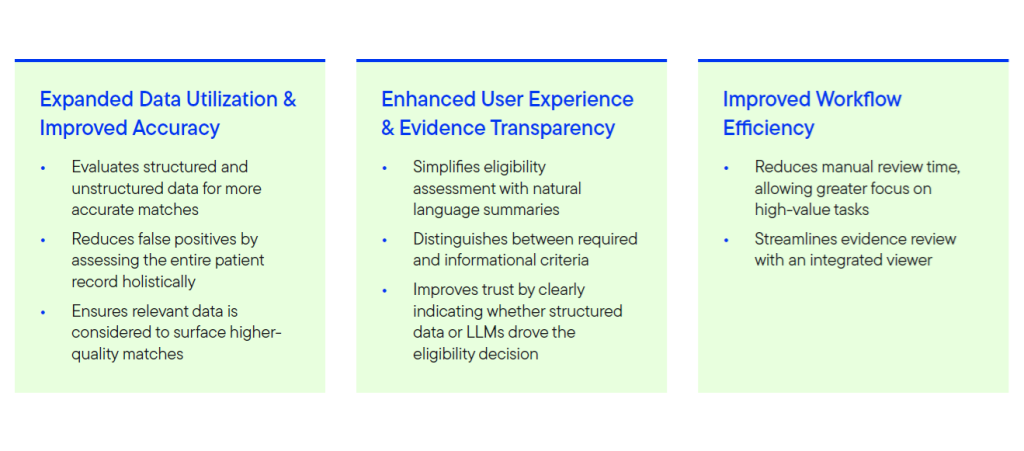
LLM-powered patient matching with AI-driven insights
Leverage advanced AI and natural language processing to simplify trial eligibility evaluation, enhance transparency, and accelerate decision-making.
Easily interpret complex clinical data with natural language summaries of eligibility findings to make quicker, more informed decision-making.
View and review evidence for each finding without having to navigate to a different screen.
Ready to streamline clinical trial screening, improve match accuracy, and accelerate recruitment? Download the document below to learn more.
