


Lyophilisation, or freeze drying, is the process in which a liquid drug is converted into a stable powder via sublimation, turning ice directly to gas under vacuum. Drugs are distributed as a ‘lyophilised cake’, so-called for their spongy, porous look, and are then reconstituted by healthcare professionals using a liquid diluent.
Today, over 30% of FDA-approved parenteral drugs are lyophilised. While the majority of these are oncology medications, freeze drying is also a popular technique for vaccines and antibiotics. In fact, 14 out of the 19 antibiotics on the Essential Medicines list are currently supplied as lyophilised powders.[i]
According to a review by Kumar et al, the number of FDA approvals for lyophilised injectables has increased by more than 300% since the 2000s.[ii] This growth is expected to continue in the coming years, rising hand in hand with the explosion of biologics on the oncology market.
“Biologic drugs like proteins, peptides, monoclonal antibodies, antibody drug conjugates, and enzymes are sensitive to temperature, oxidation, and aggregation, so lyophilisation helps to improve the stability and could also help extend the shelf life,” explains Camille Ermine, Product Manager for Vial Closure Systems at Datwyler Healthcare.
She explains that best-selling drug Keytruda was originally supplied in a lyophilised formulation, with a liquid presentation introduced later. “This is consistent with a common industry approach for biologics, where lyophilisation is often used to address formulation stability during early commercialisation,” she says.
The current landscape for lyophilisation
Beyond the rise of biologics, Ermine predicts a potential growth driver for lyophilisation in the emergence of fragile, temperature-sensitive mRNA-lipid nanoparticle vaccines and therapeutics. These products introduce significant challenges to supply execution, with increased potential for wastage and delivery delays if not addressed properly.
Such risks played out on a large scale during the COVID-19 pandemic – in England, approximately 4.7 million vaccine doses had been wasted by October 2021, with poor ultra-cold temperature control a major culprit.[iii] Freeze drying can support the stability of these delicate drugs as well as easing the cold chain requirements, helping to mitigate risks and potentially lower costs.
Antibody drug conjugates (ADCs) represent another important application, with the vast majority of these freeze-dried to maximise shelf lives and stability. The ADC market is one of the fastest growing areas of oncology, with lyophilisation contributing to safe storage and global distribution.
Such benefits are also important for small molecules such as antibiotics, enabling long-term stockpiling, preservation of potency during storage, and on-demand reconstitution in hospitals and emergency settings.
Low-volume, high-value medicines such as orphan drugs, specialty biologics, and certain advanced therapies could also benefit from lyophilisation, but Ermine says the decision should be made on a case-by-case basis. While freeze drying can extend the shelf life of these products, simplifying global logistics and reducing the risk of product loss, it introduces more process complexity, risks, and costs of its own.
“It has to be balanced,” Ermine argues, “because lyophilisation is also very complex and challenging for pharma companies.”
Lyo challenges
As Ermine says, designing a lyophilisation process and a lyo-ready product introduces a series of technical challenges, including the need for additional manufacturing infrastructure, specialized freeze dryers, and long campaigns with high energy and utility consumption.
“It’s a long cycle time, which could be one or even several days,” Ermine explains. “During this time, the freeze dryer remains occupied throughout the cycle, so any interruption or failure can result in significant time and product loss.”
New technologies including smart sensors, AI models, and novel lyophilisation techniques such as spray-freeze and spin-freeze are emerging to help manufactures mitigate these risks, but lengthy cycle times are inherent to the process. If heat is applied too quickly during primary drying, for example, the porous structure of the ‘cake’ can collapse, destroying the product.
Ensuring a successful freeze-drying process depends on several critical quality pillars. One of the most important is residual moisture control, which requires precise measurements and tight specifications, plus packaging components that limit moisture migration and protect headspace humidity.
Packaging is also tightly linked to container closure integrity (CCI). When under vacuum, packaging containers – typically vials – are stoppered, with the vacuum contributing to the seal. After this process, it’s essential to test the seal for robust CCI, ensuring the packaging system maintains the product’s sterility and quality.
Other key tests involve stability studies and extractables and leachables (E&L). “Lyophilised products require careful consideration of extractables and leachables. There’s potential for the dry cake environment to influence the behaviour of volatile compounds, including potential outgassing from packaging materials,” explains Ermine. This makes compatibility between the drug product and the container closure system a critical aspect of development.
Meanwhile, stability studies are essential. These must cover both the lyophilised cake and the reconstituted solution, ensuring the process has successfully preserved the drug’s integrity, safety, and potency.
Lyophilisation packaging trends and challenges
Today, vials are the dominant packaging format for lyophilised products, with one vial containing the lyo cake and another for the diluent. Diluents can also be provided in prefilled syringes and, to simplify administration, dual-chamber syringes are emerging featuring a front chamber for the lyo cake and another filled with diluent. When compressed by the plunger rod, a central rubber separator opens a bypass channel through which the diluent can flow into the front chamber, quickly reconstituting the drug.
“We are seeing more and more requests for these dual chamber delivery methods, which is a result of the overall market trend of shifting towards self-administration,” comments Ermine. Nevertheless, she says it is early days for dual chamber systems. With vials still the most common packaging format by a large majority, the industry’s focus remains on designing glass vial and rubber stopper systems that can withstand the harsh conditions of freeze dryers and deliver the most efficient, risk-free cycles for manufacturers.
Any displacement or tilting can affect stoppering and crimping operations and potentially impact the integrity of the final seal.”
For vial closures, Ermine describes important challenges that appear throughout the process. “When the vial arrives with a liquid formulation, the stopper is in the vented position and needs to remain there throughout filling, loading, and drying,” she says, adding that this opening is crucial for drying efficiency and uniformity. However, the vented position adds risks too. “Since the stopper is not completely closed, there is a risk it could fall off or become unstable. Any displacement or tilting can affect stoppering and crimping operations and potentially impact the integrity of the final seal.”
At the end of the drying cycle, the vented stopper is fully inserted, but the risk here is that the rubber could stick to the compression plate and be pulled up during its retraction, leading to improper sealing or the stopper falling out entirely.
“There is a small part of production between the lyophilisation and capping stages where the vial is only sealed by this stopper. So, you have to make sure that the vial remains tightly sealed in an uncapped condition for a certain amount of time and that no ‘pop up’ phenomena occurs,” states Ermine.
Choosing stoppers that mitigate these risks
Pharmaceutical manufacturers have important decisions to make when selecting the right stopper design for their lyophilised product. Components are available in both ‘two-leg’ and ‘igloo’ designs, yet neither is universally better. While multi-leg designs tend to be more symmetrical and therefore stabler in the vial neck, igloo designs offer more physical contact between the closure and the vial neck. Igloos may potentially provide better stability before full closure, but there could also be increased risk of tilting before the final compression.
Beyond stopper geometry, material choice also plays a part. Materials must be selected for their moisture control performance, with dedicated rubber compounds such as Datwyler’s FM460 offering low residual moisture to minimise the risk of transferral to the drug product across long-term storage.
Some coatings can help prevent the stopper from sticking to the compression plate but this depends on the specific type of coating. Datwyler’s OmniFlex stoppers are fully sprayed across all surfaces, including the interface between the stopper and the compression plate. This coverage provides reliable anti-sticking performance without any need for siliconisation, while the complete barrier between the elastomer and the drug product also helps to reduce E&L risks and preserve long-term stability.
On the whole, lyophilisation is complex and carries risks, yet it is also a major enabler for modern biologics, vaccines, ADCs, and orphan speciality drugs. Packaging components play a direct role in the success of pharmaceutical freeze drying, affecting process efficiency, mechanical robustness, and product quality. However, the choice of packaging format is not one-size-fits-all, depending instead on molecule type and drug properties, freeze dryer and cycle design, batch size, and cost and price expectations.
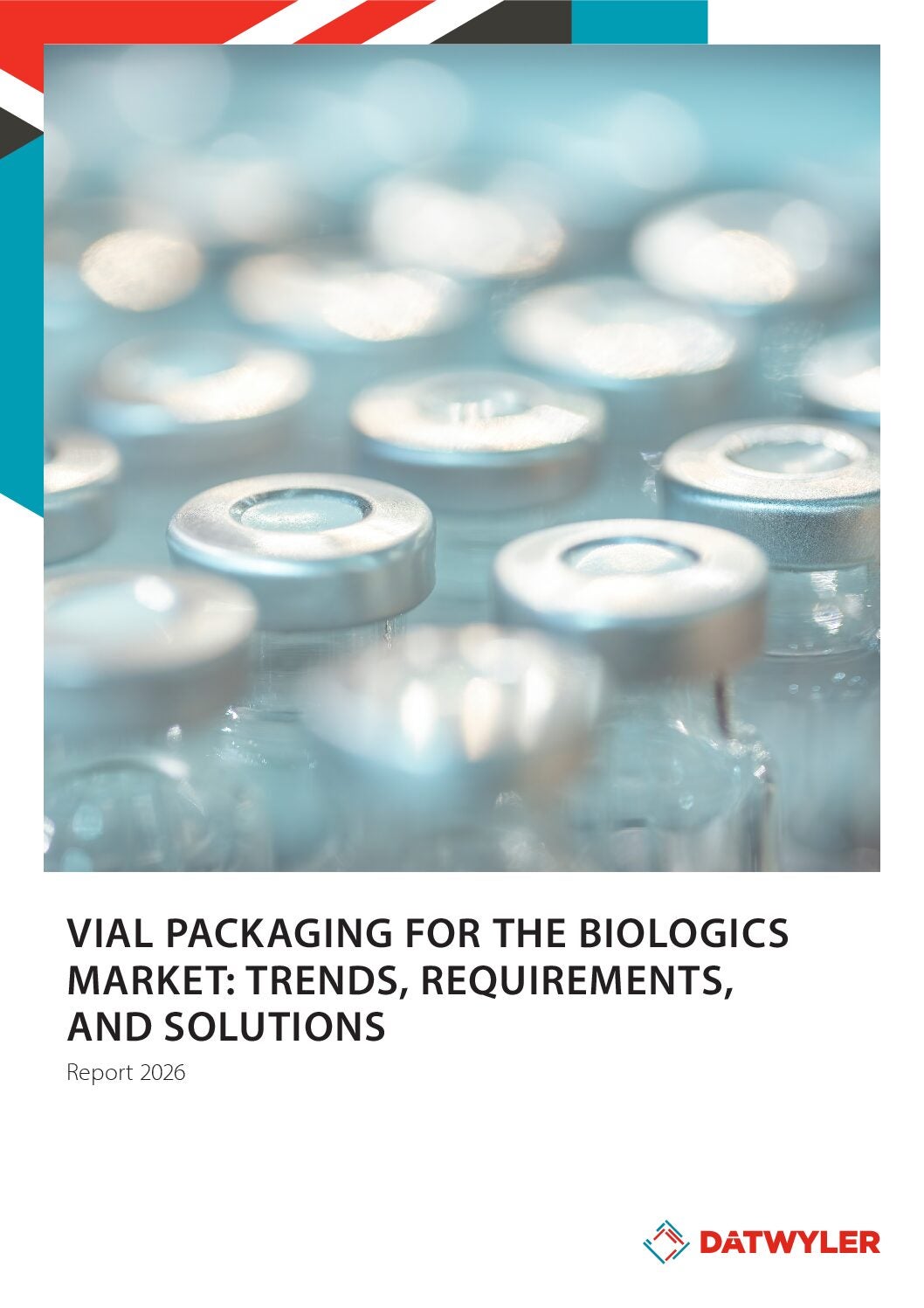
To learn more about the latest parenteral packaging challenges and solutions, please download the report below.
[i] https://pmc.ncbi.nlm.nih.gov/articles/PMC12222488/ [ii] https://www.sciencedirect.com/science/article/abs/pii/S1773224724007585 [iii] https://www.openaccessgovernment.org/the-vaccine-cold-chain-a-fragile-link-in-global-health-infrastructure/202875/
