


In the United States, an estimated 2,041,910 new cases of cancer were diagnosed in 2025, with 618,120 people dying from the disease.[i] Yet, only 7.1% of US oncology patients are estimated to participate in cancer clinical research studies.[ii]
With 2,717 trials initiated in the US across 2024 and 2025[iii], there is no dearth of active studies available. The problem, of course, is much more complex. It typically starts with low patient awareness about recruitment options, poorly defined targeted patient populations, limited understanding of the patient journey and standard of care options, followed by a variety of strict eligibility requirements that rule out many individuals based on age, comorbidities, clinical characteristics, treatment history, or biomarkers.
Time, access, and financial constraints can make it difficult for patients to participate in trials with extensive testing and visit schedules, causing eligible patients to struggle with fulfilling the complexities of a specific trial design or select out pre-consent. Also, oncology drug development is highly competitive, with added complexity to connect the right patient to the right clinical trial. This brings added risks to study recruitment.
Taken together, these dynamics make enrollment particularly challenging in oncology, where 17% of discontinued studies since January of 2023 fail due to low accrual, according to GlobalData figures.
On the other hand, trials that succeed in enrolling sufficient patients often suffer with extended timelines. According to recent GlobalData research, single-country oncology trials take an average of 36 months, or 3 years, to complete enrollment, while multinational ones take 30.8 months.
These timelines vary significantly around the world.. In North America, the average enrollment period for single-country trials enrolling between 100 and 150 participants is 32.5 months, compared to 21.7 months for comparable trials in Asia-Pacific. Enrollment speeds for certain tumor types also vary considerably. Applying the same parameters as before, the average US-based breast cancer study will complete enrollment in 29.8 months, while the average for US-based Ewing sarcoma trials is 42.3 months. Ewing sarcoma is a rare cancer typically diagnosed in childhood, representing about 1% of all pedatric cancers.[iv]
Enrollment shortfalls in oncology
The recruitment-to-randomization process begins with patients reaching out themselves, or being referred, to the study team. Pre-screening confirms early fit, typically via questionnaires, and is usually followed by a phone call to review health history and protocols in more depth. Patients sign consent forms and then enter formal screening, where specific lab tests, diagnostic imaging, or biopsies and tissue samples may be required to confirm biomarker(s), disease status, and staging before a patient can be randomized
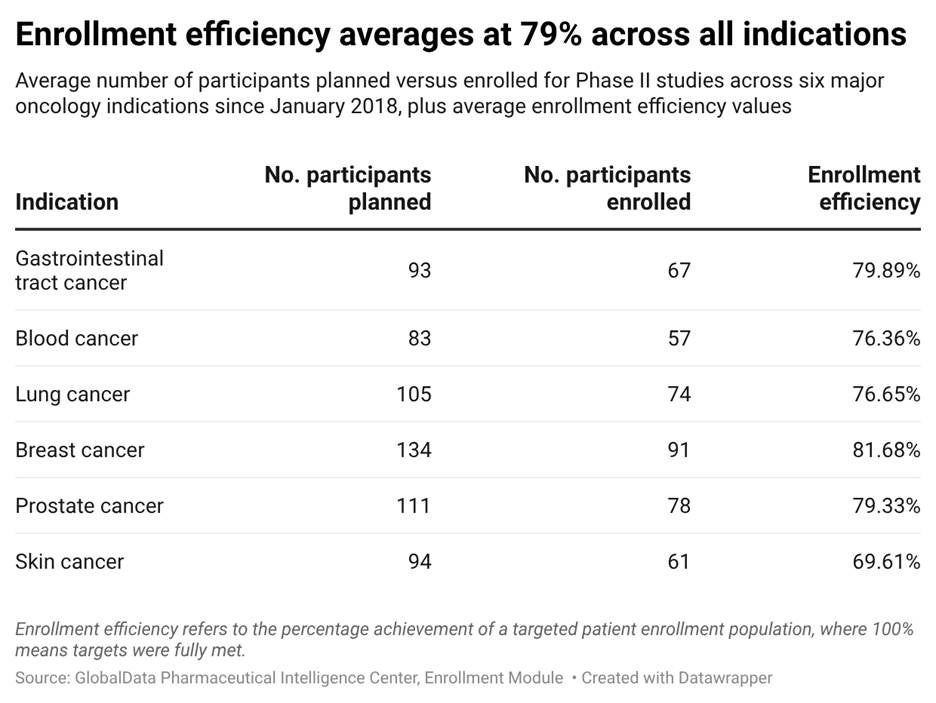
Throughout this process, it often becomes apparent that the planned number of subjects could be harder to achieve than originally thought. According to metrics from GlobalData, Phase II oncology trials plan to enroll an average of 89 participants, yet the average number of participants actually enrolled was 64 – a significant shortfall.
GlobalData uses the ‘enrollment efficiency’ metric to measure the percentage achievement of targeted enrollment populations across trials. An enrollment efficiency of 100% indicates that targets were fully met. Across the Phase II oncology studies, the average enrollment efficiency rate was 79.4%. This result could also be affected by regulatory strategy and changes, signal detection, decision-making for go-no-go, and variations across specific indications.
So, where are patients getting lost in the recruitment-to-randomization funnel?
Ineligibility and biomarker challenges
Stringent eligibility criteria have long been recognized as one of the biggest barriers to patient participation in oncology. Protocols often contain around 20 to 30 individual eligibility criteria. These help to define the specific targeted patient population as well as ensuring scientific accuracy and patient safety. Yet as a result, broad population studies suggest that only around 48% of real-world cancer patients are clinically eligible for trials.[v]
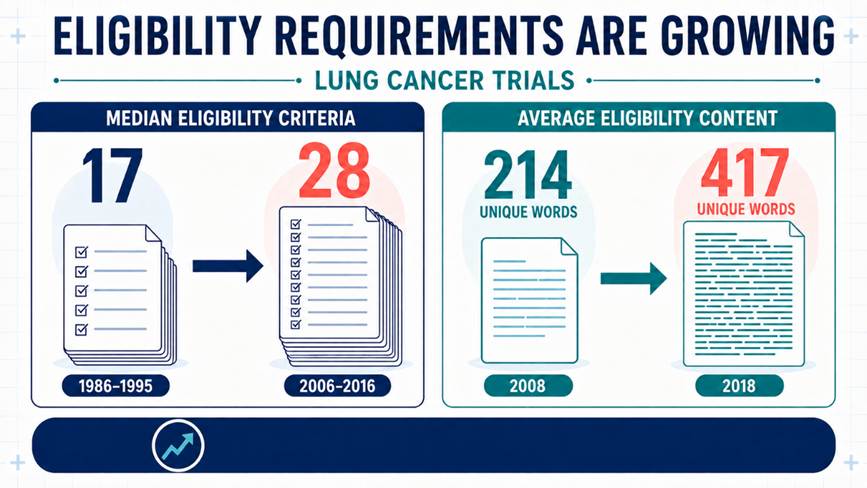
Put simply, the very thing that is helping oncology research is also hindering it. Despite many arguing for broader criteria, restrictions have only increased over the years. One longitudinal study of lung cancer trials observed an increase from a median of 17 eligibility criteria in 1986-1995 to 28 in 2006-2016[vi]. Another study found that the average volume of eligibility content had increased from 214 unique words in 2008 to 417 in 2018[vii].
Such a trend is also driven by the shift towards targeted therapies and biomarker-driven trials, where studies use biomarker-based selection methods to enroll the participants most likely to respond.
According to GlobalData, just over half of all company-sponsored Phase II oncology trials have used biomarkers within patient screening and stratification since 2020. Yet while such trials might benefit from reduced failure rates and improved designs, they are likely to face additional challenges in screening on account of testing delays, tissue availability, and assay variability problems.
In 2017, Spiegel et al. evaluated the enrollment journeys of patients across 19 non-small cell lung cancer trials – some of which depended on a fresh tissue biopsy, with central testing.
Where fresh biopsies were required, the median screening duration was 35 days, versus 15 days when no new biopsy was required. Screen failure rates were higher for the biopsy-dependent trials (49.1% versus 26.5%), with researchers concluding that ‘patient deterioration’ was the dominant reason for screen failure among biomarker-eligible patients, occurring in 56.5% of the screen failures.
Spiegel et al.’s study shows the impact that biomarker decisions can have on enrollment timelines. Not only did screening take double the amount of time when a fresh biopsy was required, the delay incurred had a severe ripple effect on patient eligibility.
Having a clear biomarker strategy and execution plan is a must. Key considerations include availability of biomarkers (i.e. in all sites, countries, and regions needed), turnaround time of testing and results, portability of data across regions, and rapid decision-making processes.
Disease progression
Fast deterioration of patients is a major challenge in oncology. While some forms of cancer can take many years to grow, aggressive types can spread rapidly. Nowhere is this more apparent than in hematology, where diseases like acute leukemia can onset suddenly and progress towards end-of-life within weeks or months without immediate treatment.
To further complicate matters, the optimal candidate for a clinical trial is often one in the early stages of cancer. Any delays that occur during the screening process, whether caused by site workflow issues, biomarker testing delays, or patient scheduling challenges, could be detrimental to the patient receiving therapies at the right point in their disease stage.
When patients become severely ill, they must withdraw from the trial due to safety and data integrity risks. Indeed, disease progression was the most common cause of screen failures in one analysis of solid-tumor cancer trials, at 16%[viii].
When patients drop out
While cancer patients may be highly motivated to join studies initially, unexpected participation burden can quickly lead to dropouts once screening begins.
Most cancer patients are treated at community-based practices[ix], yet trials are typically conducted at large academic medical centers. This adds to the logistical and financial challenge for patients, making frequent site visits unsustainable regardless of motivation. And motivation itself can also dwindle as patients learn more about the IMP, the study design, and risk of side effects.
A recent study[x] evaluated screen failures from 18 trials focused on advanced pancreatic ductal adenocarcinoma and biliary tract cancer. Of 509 patients who failed screening, withdrawal of consent was the most common reason, at 19%.
Where withdrawal reasons were available, ‘preference for standard of care’ and ‘travel constraints’ were the two most cited. Others included financial limitations, adverse event concerns, and competing trials.
Many fields in oncology are fiercely competitive, making participants highly sought after. This competition means that patients may screen for multiple studies at once to accelerate the speed with which they can access a new therapy.
When cancer patients are presented with multiple study options, they may switch or drop out for a more convenient or faster-moving trial. In this context, the importance of patient-centric protocol design and site selection is evident.
One consideration for sponsors, for example, is working with under-utilized sites in ‘research-naïve’ areas, such as a community-based site outside of major US research hubs, such as academic centers in a smaller European country or high-population regions within Asia-Pacific, specifically China. By doing so, they can access untapped patient pools and avoid competition, potentially accelerating recruitment and enrollment significantly by better targeting patient populations.
The full picture
By analyzing the entire recruitment funnel in oncology trials, the breaking points are clear to see. Strict eligibility criteria rule out more than half of patients, while poor site selection and over-inflated estimates can leave sponsors struggling to find enough patients in the area, especially in competitive indications and research hotspots.
Screening can be operationally heavy, with biomarker testing often creating a bottleneck that causes some patients to deteriorate and become ineligible as they wait for results. Finally, as the risks and requirements of the trial are better understood by patients, others withdraw due to travel burden or study complexity, while some are lost to standard of care or a competing trial.
The good news is that many of these dropoffs are not inevitable. Through better patient identification, more intelligent and strategic site selection, patient-centric protocol design, and operationally robust biomarker testing strategies, sponsors can minimize dropouts, accelerate screening, and ensure the right patients are found before the window to enroll them closes.
To learn more about strategies to improve the speed and predictability of oncology trial timelines, download the whitepaper below.
[i] https://www.cancer.gov/about-cancer/understanding/statistics
[ii] https://pmc.ncbi.nlm.nih.gov/articles/PMC11191051/
[iii] GlobalData, Pharmaceutical Intelligence Center, Clinical Trials database. Accessed August 2026.
[iv] https://www.cancer.org/cancer/types/ewing-tumor/key-statistics.html
[v] https://evidence.nejm.org/doi/full/10.1056/EVIDoa2300236
[vi] https://pmc.ncbi.nlm.nih.gov/articles/PMC5610621/
[vii] https://pmc.ncbi.nlm.nih.gov/articles/PMC9972031/
[viii] Tiu C, Loh Z, Gan CL, Gan H, John T, Hawkes E. Effect of Reasons for Screen Failure on Subsequent Treatment Outcomes in Cancer Patients Assessed for Clinical Trials. Oncology. 2019;97(5):270-276. doi: 10.1159/000501211. Epub 2019 Jul 2. PMID: 31266008.
[ix] https://pmc.ncbi.nlm.nih.gov/articles/PMC10727107/
[x] https://acsjournals.onlinelibrary.wiley.com/doi/full/10.1002/cncr.70227?
