


Rare diseases are chronic conditions that affect between 3.5% and 5.9% of the global population. About 80% of rare diseases have a genetic origin, with most beginning in childhood. These diseases causesignificantly higher overall healthcare costs than common conditions, with longer hospitalizations, more charges per admission, more readmissions, and higher mortality.
Despite this impact, treatment options are severely limited, with most rare diseases complex and poorly understood. For pharmaceutical companies, development costs are high yet commercial returns could be low, making investments higher risk. At the same time, traditional small molecule approaches cannot replace or repair a missing gene or protein – a common root cause of rare diseases – and their ‘broad spectrum’ effects make them unsuitable for many heterogenous orphan diseases. Taken together, these challenges mean that just 6% of rare diseases have approved treatments options today, leaving many patients with little hope for improvement.
Fortunately, this bleak landscape is changing as advances in genomic medicine, new diagnostic tools, awareness programs, and incentive schemes like the FDA’s Orphan Drug Act and accelerated approval pathways converge to encourage increased development efforts for rare disease therapies. As activity increases, GlobalData expects the global market for these therapies to reach $135bn in 2027, having grown at a CAGR of 55% from $19bn in 2017.
For the pharmaceutical industry, the script has flipped. Rare diseases now represent a strategic opportunity to penetrate niche markets while addressing unmet needs. Many are using pioneering therapeutic approaches – such as cell and gene therapies – to treat rare diseases at their root causes, sometimes offering potential for long-term stability or permanent cures from a single administration.
Recent milestones for CGTs in rare disease
In some disease areas, this potential is now transforming into real outcomes. Where a rare pediatric disease like spinal muscular atrophy (SMA) used to have no treatment options ten years ago, there are now four available, including two gene replacement therapies that deliver a functioning copy of the SMN1 gene directly to motor neuron cells. Many nations now screen all newborns for SMA, meaning curative treatments can be provided before irreversible nerve damage occurs.
Among more recent examples is a newly approved orphan drug for Wiskott-Aldrich Syndrome (WAS), a rare pediatric disease caused by a mutated WAS gene. Wiskott-Aldrich Syndrome is associated with persistent infections and bleeding episodes, historically requiring a stem cell transplant from a matched donor.
After decades of research, developers in Milan have successfully commercialized an ex vivo gene therapy. CD34+ stem cells are taken from the patient and transduced with a lentiviral vector encoding a healthy, functioning copy of the WAS gene. During clinical trials, severe infections reduced from 2 per year to 0.12-0.15 per year post-treatment, while moderate and severe bleeding episodes reduced from 1 to 0.16 per year.
According to GlobalData’s Drugs database, Waskyra is just one of 24 cell and gene therapies (CGTs) that are currently approved for treating rare diseases in the US. The full list comprises 15 gene-modified cell therapies, 7 gene therapies, and 2 cell therapies.
In 2025, three new rare disease CGTs were launched in the US. In addition to Waskyra, these include an autologous cell sheet-based gene therapy for treating wounds in patients with recessive dystrophic epidermolysis bullosa, as well as an adenoviral vector-based immunotherapy for recurrent respiratory papillomatosis (RRP). RRP is a rare chronic disease caused by persistent HPV infections which lead to benign growths in the air passages. Patients must have these growths surgically removed approximately four times a year[i] to preserve vocal function and avoid breathing difficulties. Papzimeos teaches the immune system how to destroy the HPV-infected cells. In clinical trials, 51% of patients were surgery free at year one. Of these patients, 14 out of 18 had still undergone zero surgeries after three years.
The CGT rare disease pipeline
There are now more than 1,500 cell and gene therapies for rare diseases in active clinical development globally. Just under three-quarters of these are for rare oncology indications such as lymphomas, myelomas, and leukaemia, followed by immunological diseases and hematological disorders. By molecule type, gene-modified cell therapies such as CAR-T therapies are the largest category, accounting for 64% of the drugs, followed by gene therapies at 20% and cell therapies at 16%.
There are several ophthalmology gene therapies in late-stage development for rare diseases, including five for retinitis pigmentosa (RP). The gene-agnostic design of Nanoscope’s MCO-010 may put it at the forefront of this group, addressing the diverse genetic mutations seen in RP patients via one injection.
Another highly anticipated product is Intellia’s NTLA-2001 for hereditary transthyretin (hATTR) amyloidosis – a progressive disease caused by mutated TTR genes which lead unstable proteins to build up as amyloid deposits in organs and tissue. Using lipid nanoparticles and a CRISPR/Cas9 gene editing system, NTLA-2001 ‘knocks out’ the TTR gene in vivo, achieving average reductions of 93% in serum TTR levels from a single intravenous dose.
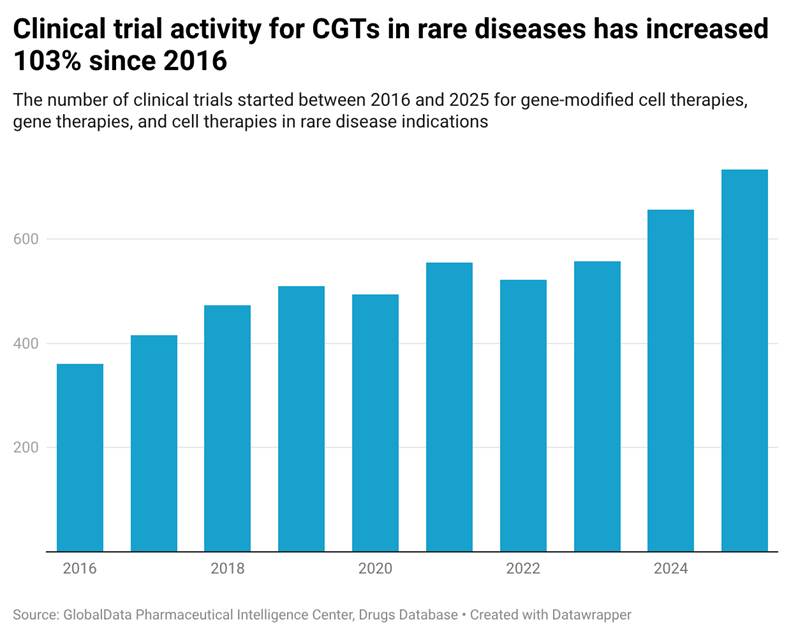
Meanwhile, in the metabolic disorders pipeline, developers are nearing approval with treatments for ornithine-transcarbamylase deficiency, Sanfilippo syndrome, Gaucher Disease Type I, familial amyloid neuropathies, and Glycogen Storage Disease 1A. Progress is accelerating rapidly. In 2025, over 700 different clinical trials were commenced for CGTs in rare disease – double the number initiated a decade ago.
Challenges lie ahead
Estimates suggest there are more than 7,000 rare diseases. While there is light at the end of the tunnel for some conditions, there is still a long way to go to close the treatment gap, and several significant challenges complicate the pathway from development to manufacturing, approval and market access.
Since CGTs are made in very small batch sizes, production costs are high and the challenge of product loss is heightened. Products may even be personalized to individual patients, meaning a lost or contaminated batch could lead to clinically devastating delays. To worsen this challenge, biologically active components like viral vectors, nucleic acids, and lipid nanoparticles are extremely fragile, relying on precise cold chain conditions and aseptic processing to avoid degradation.
Because cell and gene therapies carry unique biological risks, regulatory and documentation standards are more demanding than for traditional drugs. Yet at the same time, quality control is complicated by the inherent variability that comes with starting material derived from patients and donors. Bespoke analytical methods must also be developed to measure complex attributes, including sterility and potency.
During clinical trials, the challenges continue. Since orphan drugs target conditions that, by the US definition, affect less than 200,000 people nationwide, clinical trial participants can be hard to locate. Complex, multinational networks are essential, yet each site may only yield a few patients each. In addition, specialized centers are typically required for administering cell and gene therapies, with enhanced safety monitoring to mitigate the risk of severe side effects.
Because of these challenges, trials can take longer and amass high costs, making premium price points necessary to recoup the losses. However, after regulatory approval, payers may be hesitant to reimburse high-cost CGTs without long-term durability data. This makes post-launch real world evidence generation essential for strengthening the narrative and expanding coverage over time.
As the rise of CGTs drives the next stage of growth for orphan drugs, developers must confront the complexities of two of the most demanding areas of drug development in order to bring these advanced therapies to small, underserved patient populations. Despite the challenges, the landscape is evolving and maturing, with growing clinical pipelines and new product launches reshaping the outlook for rare disease treatment.
[i] Welschmeyer A, Berke GS. An updated review of the epidemiological factors associated with recurrent respiratory papillomatosis. Laryngoscope Investigative Otolaryngology. 2021; 6: 226–233. https://doi.org/10.1002/lio2.521
