


Plans to investigate US reliance on overseas pharmaceutical manufacturing and supply chains are set to reveal the country’s reliance on European drug manufacturing, potentially putting the region’s sector at risk as the US seeks to strengthen its domestic manufacturing capabilities. One of the aims of the Pharmaceutical Investment Oversight and Accountability Act, which was re-proposed on 15 July 2026, is to promote onshoring of pharmaceutical manufacturing and discourage US reliance on foreign-made drugs. GlobalData data suggests that such an investigation could significantly impact Europe as the largest manufacturer of FDA-approved innovator and biosimilar products, potentially exposing the region to tariff and non-tariff actions as the Trump administration continues with its efforts to onshore pharmaceutical manufacturing.
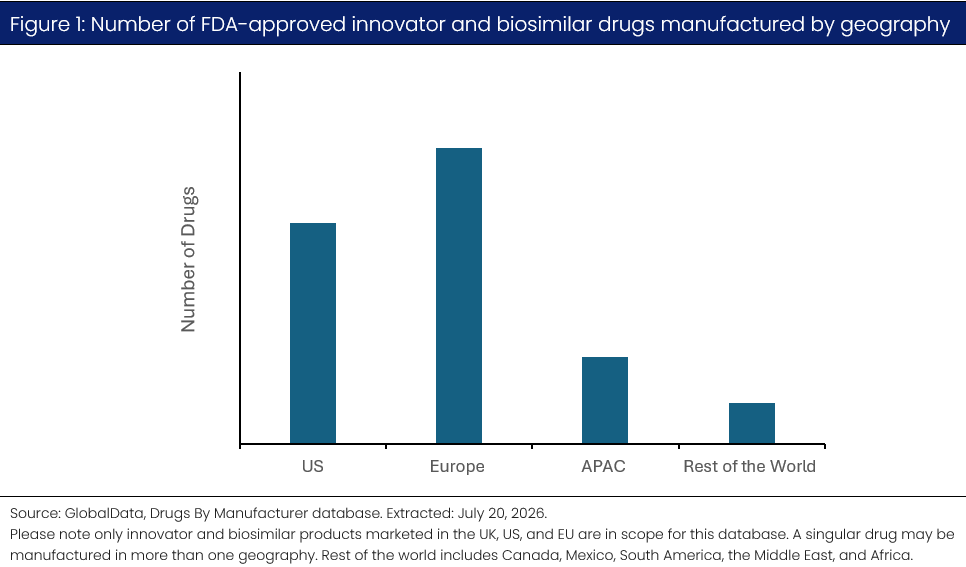
As per the figure below, GlobalData’s Drugs By Manufacturer database reveals that the majority of FDA-approved innovator and biosimilar drugs are manufactured in Europe, exceeding the US by approximately a third. Germany dominates European drug manufacturing, accounting for 35% of the region’s FDA-approved innovator and biosimilar production. Just under 600 drugs are manufactured in Asia-Pacific, with just over half of those attributed to India and China. The rest of the world, including Canada, Mexico, South America, the Middle East, and Africa, accounts for the smallest share of FDA-approved innovator and biosimilar pharmaceuticals manufacturing, collectively producing just 272 drugs.
Go deeper with GlobalData

As Europe’s leading manufacturer of FDA-approved innovator and biosimilar drugs, Germany could face the biggest hit from the proposed bipartisan legislation. The country’s pharmaceutical manufacturing success can be greatly credited to the outsourcing of FDA-approved biologics to specialised, German-based contract development and manufacturing organisations (CDMOs) such as Vetter Pharma-Fertigung, which alone holds contracts for 74 FDA-approved drugs, primarily biologic and injectable products. Germany currently produces 40% of Europe’s FDA-approved biologics, highlighting the country’s reputable biologic and sterile fill-finish capabilities. Bill co-sponsor Senator Elizabeth Warren, who wishes to increase domestic manufacturing capacities through new legislation, claims that securing this investigation is the first step in strengthening US drug supply chains, suggesting the underlying intent to identify and target certain manufacturing markets with tariffs and other policies to incentivize onshoring of pharmaceutical supply chains. Such an outcome could be detrimental to Germany and its CDMOs.
Germany is also facing pressure on another front. On 18 June 2026, the US Trade Representative (USTR) announced their investigation into Germany’s innovative drug pricing under Section 301 of the 1974 Trade Act. The Trump administration is aiming to determine if Germany is persistently and unreasonably underpaying for innovative pharmaceuticals, and its impact on US commerce. Since US drug pricing is notoriously higher than many European countries, USTR ambassador Jamieson Greer and President Trump argue that global pharmaceutical R&D shares should not be disproportionately borne by American patients. The outcome of the pending investigation will determine if Germany is paying its “fair share” according to Greer and could result in tariff and non-tariff actions.
In line with the Trump administration’s wider trend of policies to onshore pharmaceutical manufacturing, both the Pharmaceutical Investment Oversight and Accountability Act and the UTSR investigation may serve as pathways to implement future policy actions targeting regions and countries like Germany, supplying the US pharmaceutical market. While this may increase US control over its supply chains and encourage biopharma companies and CDMOs to preferentially invest in US-based facilities, the finite domestic capacity and qualified personnel could constrain the administration’s plans to effectively reroute its dependence from Europe and other suppliers.

