
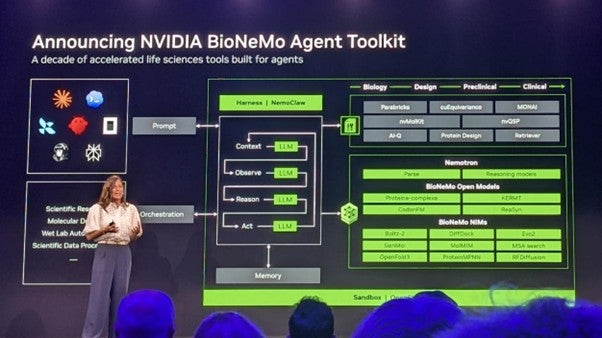
NVIDIA has unveiled the BioNeMo agent toolkit, a package of tools for life sciences R&D designed specifically for use by artificial intelligence (AI) agents.
“The $300bn life sciences R&D industry is at an inflection point,” said Kimberly Powell, vice president, NVIDIA Healthcare , at the 2026 BIO International Convention in San Diego, which is taking place 22–25 June. “The question is no longer whether AI can help science. The question is, does AI have the right instruments to run science?” She noted that general-purpose agents can undertake research but spend considerable time and computing power finding and operating the right research tools and often fail to use them successfully.
Go deeper with GlobalData


Discover B2B Marketing That Performs
Combine business intelligence and editorial excellence to reach engaged professionals across 36 leading media platforms.
According to Powell, NVIDIA’s BioNeMo toolkit bridges this gap by presenting AI agents with the full range of tools needed to conduct research while instructing agents on how to use them and troubleshoot when things go wrong. Among the tools included, Powell mentioned the imaging framework MONAI, genomics tool PaReBrick, and modelling software cuEquivariance.
NVIDIA’s announcement also touched on the toolkit’s use in closed-loop workflows. An NVIDIA representative told Pharmaceutical Technology that BioNeMo could support iterative loops of experimentation in which AI suggests new scientific questions based on past results.
“Nearly 50 partners are already adopting the BioNeMo agent toolkit,” Powell revealed. She mentioned four partners building new AI agents using these tools: Dessault Systèmes’ virtual companion Marie; Lila Sciences’ modelling AI; Schrödinger’s discovery agent Bunsen; and Tecan’s automation AI Introspect.
Powell stressed that the toolkit is “agnostic” to both the AI agents using it and their harnesses—the software that sets the rules for agents to follow. She also said NVIDIA is partnering with leading AI cloud developers to provide broad access and enable scientific workflows at scale.
On a global front, NVIDIA has had to navigate geopolitical changes. In April 2025, the US administration said the company would need an export license to sell is H2O processor, limiting its exports. Despite this, Powell told Pharmaceutical Technology that there would be no international barriers for use of the BioNeMo toolkit, including in China.


