

Over the past decade, there have been several core scientific and technological developments that have paved the way for a rare disease revolution – with new therapeutic modalities, in silico modelling and the growing access to genomic sequencing all demonstrating potential in facilitating treatment.
However, therapeutic advancements mean nothing to patients who cannot receive them, as issues around access and reimbursement, as well as regulatory and economic hurdles continue to plague individuals with rare diseases.
Go deeper with GlobalData


Discover B2B Marketing That Performs
Combine business intelligence and editorial excellence to reach engaged professionals across 36 leading media platforms.
These challenges were raised from a very personal perspective by ex-UK prime minister David Cameron and Julia Vitarello, founder and CEO of Mila’s Miracle Foundation, during a fireside chat at the 2026 DIA-MHRA Global Summit, held during the London Life Sciences Week.
During the session, Cameron and Vitarello each shared their experiences as parents of Ivan and Mila, two children with rare diseases who both sadly passed away following their battles with Ohtahara syndrome and Batten disease, respectively. While no treatment was available to Ivan for his condition during his life, Mila did eventually secure access to a therapy catered to her specific mutation – a feat that Vitarello called a “Herculean effort”.
“My daughter received a medicine one year later, after a fight with the Boston Children’s Hospital, that became the first individualised medicine in the world,” Vitarello commented, adding that Mila set a record in the world that has “snowballed into where we are today”.
However, Vitarello caveated that Mila’s case is exceptional, as a lion’s share of children with rare diseases are unable to access potentially life-saving drugs for their condition.
Throughout the DIA-MHRA Global Summit, speakers were laser-focused on addressing the access gap in rare diseases – with discourse primarily turning to the need for regulatory reform, further encouragement of technological advancements, patient-centric clinical trial design and the role of data in guiding treatment and therapeutic development.
The role of technology in boosting rare disease access
Currently, the artificial intelligence (AI) revolution is fundamentally changing the paradigm in drug discovery and development. However, speakers noted the technology’s role does not stop there, as it can also be used across a plethora of applications in the rare disease space.
According to Professor Fyodor Urnov, director of therapeutic R&D at the Innovative Genomics Institute (IGI) and a professor in the department of molecular & cell biology at UC Berkeley, who was involved in the creation of the treatment for Baby KJ, the field has come a long way in a short time with AI. Currently, he says it takes around a month to design a clinic-grade editor for a specific mutation across immune and metabolic diseases, as well as conditions of the blood, liver, and skin.
“We have collaborations with Anthropic and OpenAI to limit that time,” Urnov commented, noting that AI in the future will be able to design an editor in as little as 12 hours – a potential revolution in treatment for patients with monogenic rare diseases.
Cameron also touched upon this, adding that advancements in research and treatment driven by a combination of genomics and AI will allow the Milas and Ivans of the future to be managed by the healthcare system in a completely different way. “Not all patients will get a treatment, but they may get a better diagnosis, and we can understand more why a rare disease has happened and where it came from,” Cameron commented.
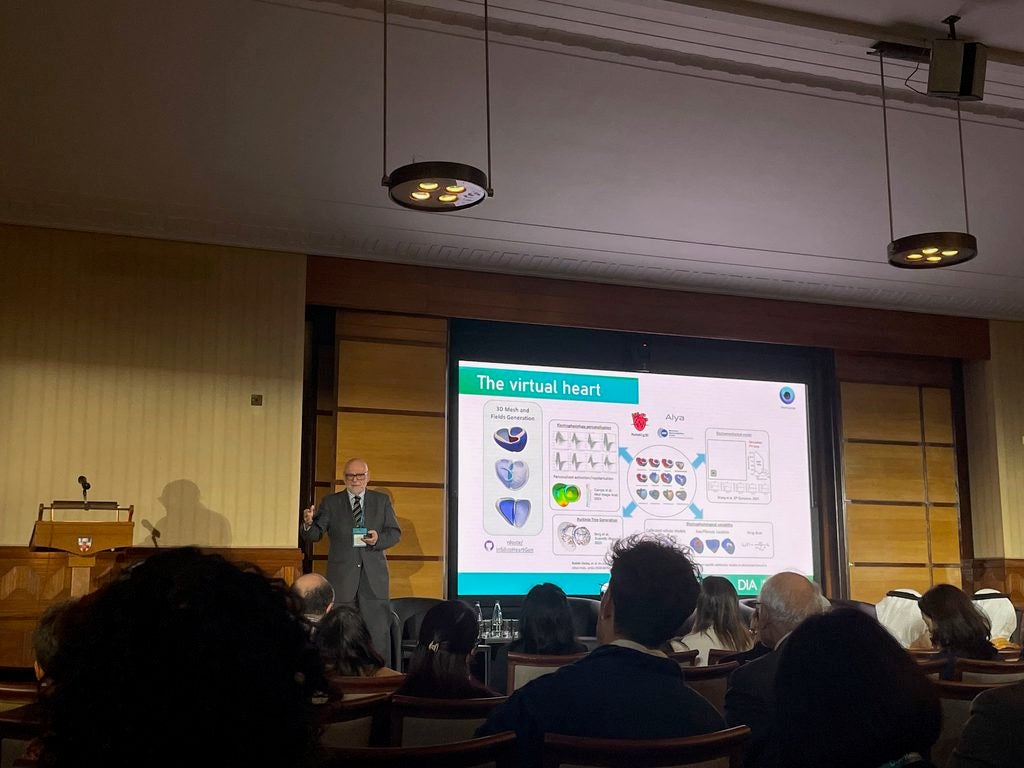
According to the CEO of the Saudi Food and Drug Administration (SFDA), Professor Hisham Aljadhey, in silico modelling will also play a key role in scaling treatments for rare diseases. In a talk, CSO of MedGenie, Professor Michael von Forstner, noted that digital twins are also set to revolutionise the rare disease setting, as they can overcome the challenging and potentially unethical hurdle of randomising patients in clinical trials.
“There are approaches to use digital twins in rare diseases that combine the input of data, modelling, and personalisation on the individual patient in order to build models that predict the outcomes that could happen in an individual child if they get a sample treatment,” Forstner commented.
On top of its potential to uncover disease mechanisms to guide treatment, Kevin Lee, director and CEO of UK biotech, Bicycle Therapeutics, noted that the debut of such technologies into discovery, development, clinical trials and manufacturing could help to bring down treatment costs in the future by streamlining processes across the value chain.
Thinking about research design and data collection
For researchers to pursue the most productive avenues in rare disease development, experts also point to the need to improve research design and promote widespread data collection.
On the research design side of the equation, Chris Hollowood, CEO and chief investment officer of Syncona Investment Management, noted that there should be more flexibility around p-values in rare disease.
“If you’ve taken a gene insertion that sits on a platform that’s already been to clinic in a monogenic recessive disorder, that p-value should not be 0.05. If the regulators give us staggered p-values on a platform basis, first approved 0.05, second 0.1, third 0.15, that reduces the risk so it can actually become commercial,” Hollowood commented.
Alongside an evolving approach to trial design, experts also pointed to the need to collate as much data as possible on rare disease populations through initiatives like newborn genomic screening outside of the context of rare disease with approved therapies.
Focusing only on diseases with available treatment options is a mistake, Cameron believes, as screening for a broader range of rare conditions would help to collate data and build a resource that he says would greatly benefit both researchers and parents of patients. He also highlights the potential of using said data to recruit patients into clinical trials, as identifying eligible patient populations in rare disease trials can be a major bottleneck.
Targeting regulatory reform for rare diseases
While science and technology may be advancing at a rapid pace, Vitarello and Cameron warned that the regulatory landscape is not keeping pace. They make this remark as global regulators increasingly acknowledge that their approaches applied to more common diseases are neither feasible nor sustainable for rare disease drugs.
To tackle this challenge, the UK’s Medicines and Healthcare products Regulatory Agency (MHRA) has debuted the Rare Disease Framework, which sets out to create a more flexible, risk-proportionate approach to rare disease development to improve access. In a panel, Urnov stressed that risk proportionality is a key consideration in rare disease regulation, and that the severity and patient burden of many rare conditions justify more flexibility in regulation.
Aside from the Rare Disease Framework, the MHRA is also working closely with the UK’s health watchdog, the National Institute for Health and Care Excellence (NICE), through its aligned pathway. Through this initiative, the pair hope to bring medicines to patients up to six months sooner by converging regulatory and National Health Service (NHS) payer decision-making across Britain.


