
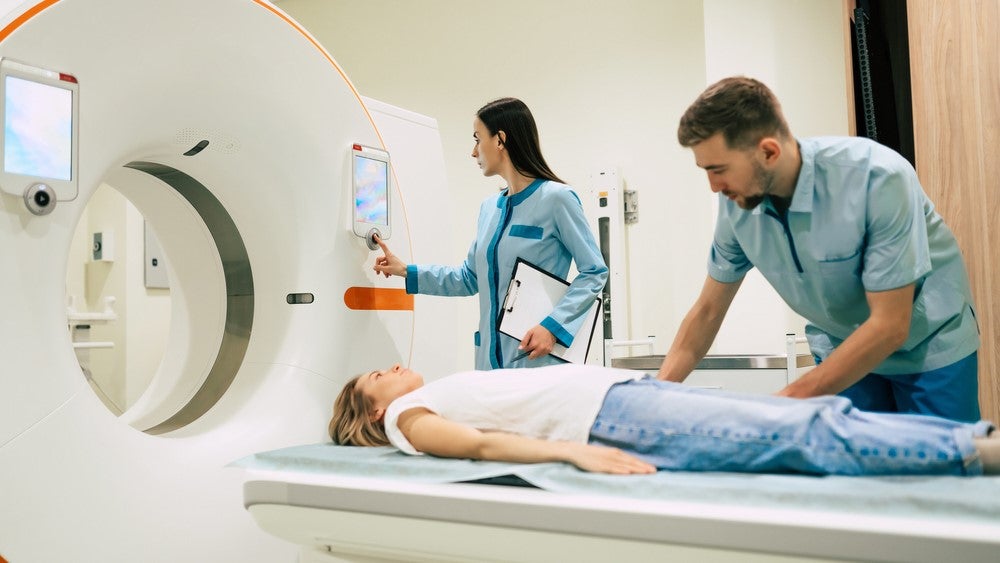
The UK national scanning programme, National PET Imaging Platform (NPIP), has been launched to conduct total-body positron emission tomography (PET) imaging to accelerate drug discovery.
The NPIP was created in partnership with Medicines Discovery Catapult, the Medical Research Council, and Innovate UK, with operations beginning in April 2024. The project received £32m ($38.8m) in funding from the UK government through the UK Research and Innovation (UKRI) Infrastructure Fund.
Go deeper with GlobalData


Discover B2B Marketing That Performs
Combine business intelligence and editorial excellence to reach engaged professionals across 36 leading media platforms.
The NPIP project is part of the UK government’s push to boost its life sciences sector while disbursing multiple grants to support drug discovery and development across multiple therapies.
NPIP will provide access to total-body PET imaging for clinicians, academics, and industry. The cost of conducting a PET scan remains a barrier to early diagnosis of many diseases, including Alzheimer’s. A detailed picture of anatomy through a PET scan can help to develop drugs and diagnostics for complex diseases such as cancer, cardiovascular and neurological diseases.
“Equitable and rapid access to state-of-the-art PET scanners will provide dementia researchers and clinicians with a new tool to better understand the complex mechanisms that underpin this condition,” said Alzheimer’s Research UK chief executive Hilary Evans.
“We hope it will also support the delivery of dementia clinical trials through increased efficiency and participation and could help embed research in clinical practice across the UK.”
The total-body Biograph Vision Quadra PET/CT scanners for the NPIP are supplied by Siemens Healthineers. They are in the Royal Infirmary of Edinburgh and St Thomas’ Hospital (London), one at each site and jointly managed by the Universities of Edinburgh and Glasgow in Scotland, King’s College London and Imperial College London.
The total-body PET scans being quicker allows for more information to be collected whilst exposing patients to considerably lower doses of radiation. Thereby allowing more patients to be scanned and recruited in a clinical trial.
There have been advancements in imaging agents being developed, including those for PET imaging. GlobalData forecasts the UK nuclear imaging market to be worth about $27m in 2030.
GlobalData is the parent company of Pharmaceutical Technology.
NPIP will also maintain a database for all the PET scan information and connect insights from many research programmes and trials.


