
Nipah Virus and the 75% Fatality Threat
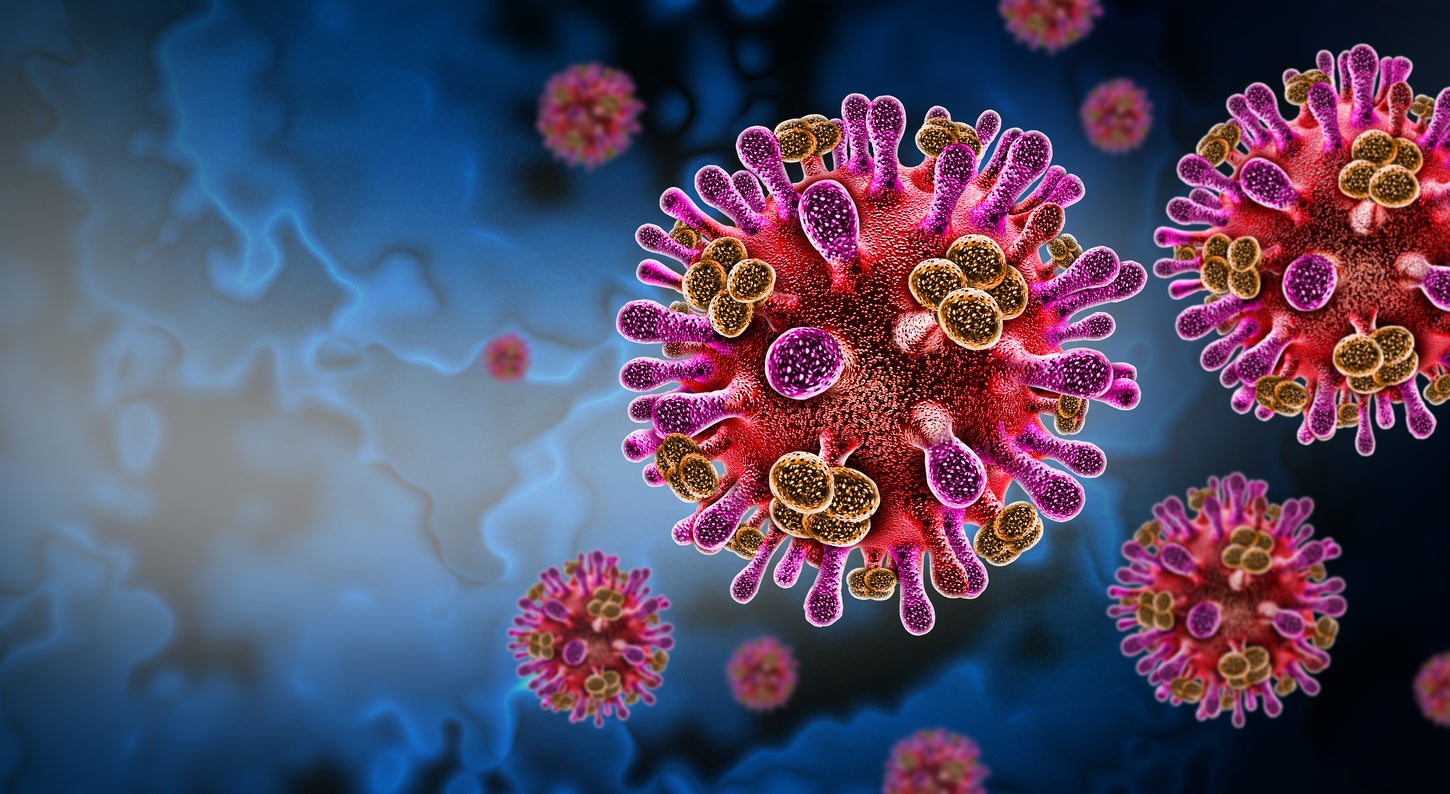
Nipah virus (NiV) is a deadly zoonotic RNA virus in the genus Henipavirus that causes severe encephalitis and respiratory disease, with case fatality rates reaching 40%–75%. Since its 1999 identification in Malaysia, outbreaks have occurred periodically across South and Southeast Asia1.

As a global supplier of viral reagents, Sino Biological offers a comprehensive range of viral research tools for Nipah virus research, empowering scientists to engineer the broad-spectrum therapeutics essential for outbreak response and global pandemic preparedness.
Structure and pathogenesis of NiV
NiV is a negative‑sense, single‑stranded RNA virus with a relatively large genome of ~18.2 kb encoding six structural proteins. The virions are pleomorphic, typically spherical or filamentous, with diameters ranging from approximately 120nm to 500nm, and possess a lipid envelope. Nipah virus G protein binds ephrin‑B2/B3 on endothelial cells and neurons, and its F protein mediates pH‑independent membrane fusion and syncytia formation, underlying its neurotropism and virulence1-3.
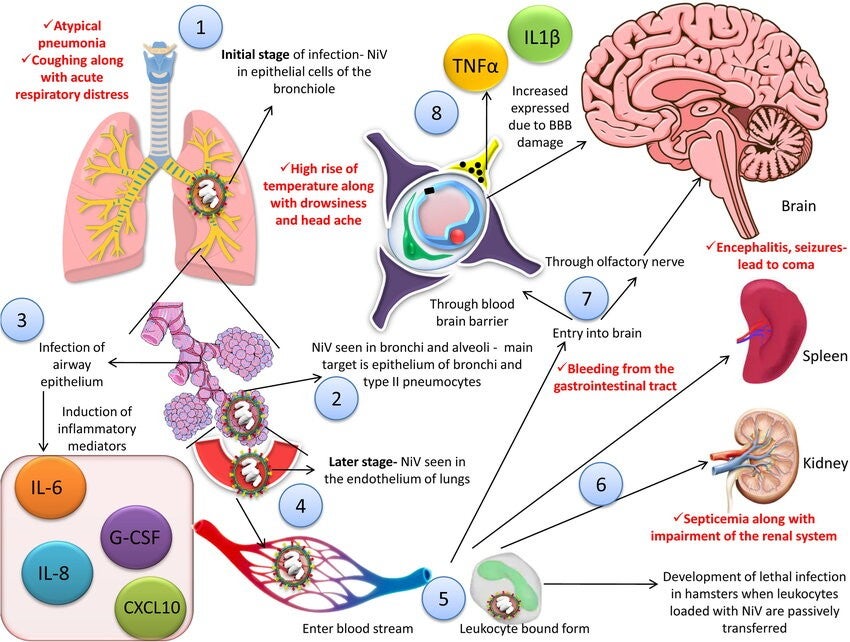
Pathogenesis of NiV: The virus first infects bronchiolar and alveolar epithelial cells, causing local inflammation and the release of inflammatory mediators. It then spreads to pulmonary endothelial cells, enters the bloodstream (free or within infected leukocytes), and disseminates to the brain, spleen, and kidneys. NiV reaches the central nervous system (CNS) via the hematogenous route and anterograde transport along olfactory nerves, leading to BBB disruption and upregulation of IL‑1β and TNF‑α, which drive the development of neurological symptoms in humans (shown in red) 2. Figure source: https://www.tandfonline.com/doi/full/10.1080/01652176.2019.1580827
Immune evasion
NiV has evolved multiple immune evasion mechanisms that contribute to high viral loads and severe disease. The P gene encodes multiple non‑structural proteins (P, V, C, W) that interfere with type I interferon (IFN‑α/β) signalling by blocking STAT1/STAT2 phosphorylation and nuclear translocation, thereby dampening the antiviral state 3.
The V protein additionally antagonises MDA5 and RIG‑I, suppressing IFN production. Some studies also suggest that NiV V protein can inhibit the classical complement pathway, reducing opsonisation and lysis of infected cells. This combination of neurotropism, endothelial damage, and immune suppression underpins the high case fatality (40%–75%) and the risk of nosocomial transmission4.
Structure‑based design of vaccines and therapeutics
Rational vaccine and antibody development relies on structural and functional characterisation of NiV’s surface glycoproteins. The G protein contains a receptor‑binding domain (RBD) that specifically engages ephrin‑B2/B3, while the F protein exists as a metastable prefusion state on the virion surface and is cleaved into F1 and F2 by host furin to become fusion‑competent5.
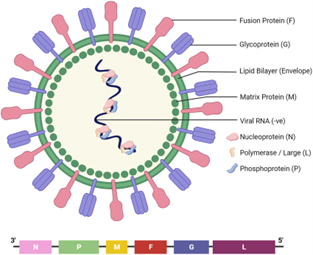
Nipah virus (NiV) has six structural proteins: nucleoprotein (N), phosphoprotein (P), matrix protein (M), fusion protein (F), receptor‑binding glycoprotein (G), and RNA‑dependent RNA polymerase (L) 6. Figure source: https://www.imrpress.com/journal/JIN/23/5/10.31083/j.jin2305090
Most vaccine candidates are based on recombinant NiV G or F proteins, virus‑like particles (VLPs), or viral vectors (e.g., vesicular stomatitis virus, VSV, or adenovirus) expressing NiV glycoproteins. Preclinical studies in hamster and ferret models show that immunisation with prefusion-stabilised F or soluble G induces high‑titer neutralising antibodies and protects against lethal NiV challenge. mRNA‑based platforms are also being explored, encoding NiV G or prefusion F to drive robust humoral and cellular immune responses.
Neutralising monoclonal antibodies (mAbs)
Neutralising mAbs are a major therapeutic strategy for NiV, with several candidates in preclinical and early development. Potent mAbs typically target either the G protein RBD (blocking receptor binding) or the prefusion F protein (inhibiting conformational changes required for fusion)7,8.
Key functional assays to characterise these mAbs include:
- Pseudovirus neutralisation tests (PNT) using VSV or lentiviral pseudotypes bearing NiV G and F, which allow safe, high‑throughput screening in BSL‑2 labs8.
- Live‑virus plaque reduction neutralisation tests (PRNT) in BSL‑4 laboratories to confirm neutralisation potency.
- Effector function assays (e.g., ADCC, phagocytosis) to assess Fc‑mediated clearance of infected cells9.
Cryo‑EM and X‑ray crystallography studies of mAb–NiV glycoprotein complexes are used to define neutralising epitopes, map escape mutations, and guide engineering of broad‑spectrum mAbs effective against both Malaysian (NiV‑M) and Bangladesh (NiV‑B) strains, as well as related henipaviruses9.
Sino Biological’s role in translational NiV research
Sino Biological supports this translational pipeline by supplying recombinant NiV reagents used in academic and industrial labs worldwide. Their product line includes:
- Recombinant NiV G protein (both NiV‑M and NiV‑B strains) produced in mammalian cells, with high affinity for ephrin‑B2/B3, used as antigens in ELISA, AlphaLISA, and as immunogens for mAb generation.
- Recombinant NiV F protein, typically in a prefusion-stabilised form, which is critical for screening neutralising mAbs and evaluating vaccine‑induced responses.
- cDNA clones of NiV G and F genes, enabling rapid expression of viral glycoproteins for pseudovirus neutralisation assays, immunogenicity studies, and epitope mapping.
By providing well-characterised, functionally validated NiV proteins and molecular tools, Sino Biological accelerates the discovery of broadly neutralising mAbs, structure‑guided vaccine design, and the development of rapid, sensitive diagnostic assays needed for outbreak response and pandemic preparedness.
References
- Chua KB, et al. (2000). Nipah Virus: A Recently Emergent Deadly Paramyxovirus. Science, 288(5470):1432-5. doi:10.1126/science.288.5470.1432
- Singh RK, et al. (2019). Nipah virus: epidemiology, pathology, immunobiology and advances in diagnosis, vaccine designing and control strategies. Vet Q, 39(1):26-55. doi:10.1080/01652176.2019.1580827
- Rodriguez JJ, et al. (2002). NiV V Protein Evades Interferons by Preventing STAT1/2 Activation. J Virol, 76(22):11476-83. doi:10.1128/JVI.76.22.11476-11483.2002
- Eichhorn G, et al. (2015). A novel factor I activity in NiV inhibits human complement pathways. J Virol, 89(2):1133-43. doi:10.1128/JVI.02459-14
- Negrete OA, et al. (2005). EphrinB2 is the entry receptor for Nipah virus. Nature, 436(7049):401-5. doi:10.1038/nature03838
- Al-Obaidi MMJ, et al. (2024). Nipah Virus Neurotropism: Insights into BBB Disruption. J Integr Neurosci, 23(5):90. doi:10.31083/j.jin2305090
- Nie J, et al. (2019). Nipah pseudovirus system for evaluation in non-BSL-4 facilities. Emerg Microbes Infect, 8(1):470-81. doi:10.1080/22221751.2019.1590124
- Bossart KN, et al. (2009). Neutralizing human mAb protects against lethal NiV in ferrets. PLoS Pathog, 5(10):e1000642. doi:10.1371/journal.ppat.1000642
- Dang HV, et al. (2019). Structural basis for antibody-mediated neutralization of NiV. PNAS, 116(50):25057-67. doi:10.1073/pnas.1915202116