

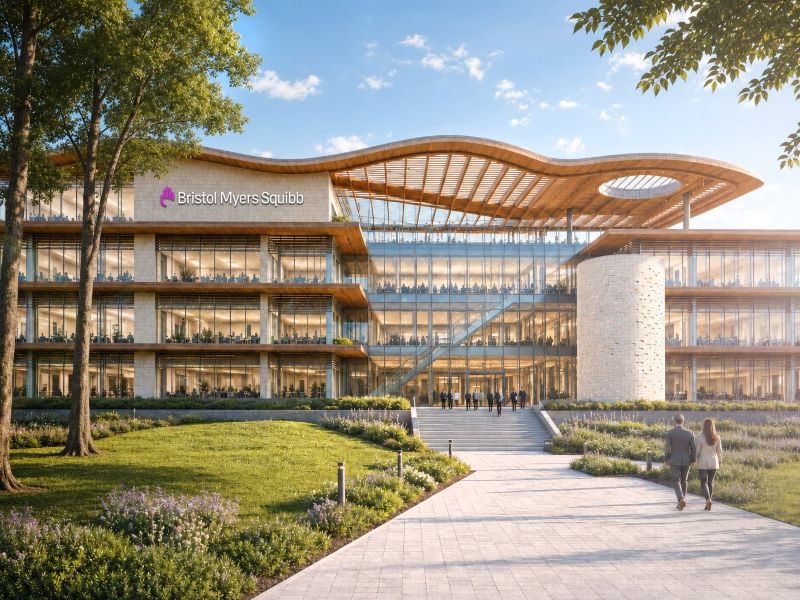
Bristol Myers Squibb (BMS) plans to establish a new manufacturing campus in Houston, Texas, US.
The project represents an estimated investment of $2.3bn and is intended to expand domestic manufacturing capacity to support the development and delivery of next‑generation therapies. It forms part of BMS’ five‑year, $40bn programme in the US covering research and development, technology and manufacturing.
Recommended White Papers

Recommended Buyers Guides

BMS announced the project in August 2026. Construction is scheduled to commence in 2027, with operations targeted for 2030.
The site is projected to create nearly 500 highly skilled positions across operations, production, maintenance, engineering, quality control and assurance, as well as site leadership and administrative functions.
BMS also anticipates the creation of around 2,000 construction and other indirect roles during the construction period.
Location
BMS’ new manufacturing campus will be located in Generation Park, a commercial development in north-east Houston. Spanning 4,300 acres, Generation Park serves as a purpose-built hub for life sciences and advanced manufacturing.
The company chose Generation Park after a comprehensive, competitive assessment of several markets across the central and eastern US. Considerations included the developing depth of the regional life sciences talent pool, available incentives, access to utilities and transport infrastructure, and a broader business environment supportive of long-term expansion.
Furthermore, Houston provides a combination of research institutions, workforce development pathways, suitable real estate and a pro-business setting. The area hosts six medical schools, three tier-one research universities and specialised training through San Jacinto College’s National Institute for Bioprocessing Research and Training-licensed Center for Biotechnology, Lone Star College and Texas A&M’s National Center for Therapeutics Manufacturing.
The region has also drawn an expanding range of life sciences companies including locally grown operators such as Neurogene and CellReady, as well as relocations such as BioNova Scientific and Cellipont.
Bristol Myers Squibb manufacturing campus details
Bristol Myers Squibb’s new manufacturing campus in Houston, Texas, will cover approximately 600,000ft² (55,741m²) and is being designed as a modular, multimodal facility to support flexibility and long‑term expansion.
The modular architecture will enable the company to add and/or reconfigure manufacturing capacity in line with its current and anticipated pipeline requirements.
The multimodal set‑up is intended to support production of multiple medicine types including small molecules, biologics and antibody‑drug conjugates across a range of therapeutic areas, covering drug product and finished goods from late‑stage development through to commercial launch.
The campus will also be configured for adaptability, with flexibility to accommodate future developments in digital integration and automation, to maintain up‑to‑date biopharmaceutical manufacturing standards as technologies advance.
BMS expects the site to increase in both scale and capability over time beyond its initial configuration.
Incentives
A Texas Enterprise Fund grant of $4.89m has been awarded to BMS. TEF is a performance-based financial incentive to draw new business investments and new jobs to the state. It is managed by the Texas Economic Development & Tourism Office within the Office of the Governor.
The project also qualifies under the Texas Jobs, Energy, Technology, and Innovation programme, a recently introduced competitive economic incentive mechanism intended to attract employment and capital investment to the state.
Marketing commentary on Bristol Myers Squibb
BMS is a New Jersey-based biopharmaceutical company focused on discovering, developing and delivering innovative medicines that help patients prevail over serious diseases.
The company offers contract manufacturing services in Texas for both commercial and clinical trial manufacturing and, in 2025, had 250 clinical trial sites throughout the state to advance clinical research across its portfolio. As of 31 December 2025, the company had approximately 32,500 employees in 43 countries.
