


While these transfers are a normal part of business, navigating them requires a strategic approach to ensure smooth and efficient execution with reliable results. Discover the nine key principles that will guide you through a successful tech transfer, enabling proactive planning, reducing risks, and fostering productive partnerships.
1. Leverage an integrated network approach
Streamline your tech transfer processes and communication by retaining as many activities as possible with a single, experienced vendor. An integrated network approach simplifies project management, reduces communication barriers, offers a single point of contact, and enables you to identify bottlenecks early on. This approach accelerates timelines while enhancing efficiency and transparency, providing seamless opportunities for collaboration and successful project delivery.
2. Perform a full FMEA and gap analysis before PPQ
Go through every part of the process to look at failure modes, effect analytics, and gap assessments, while ranking the result and likelihood of impact. Taking a few days for a diligent approach on the front end can significantly mitigate the risks and save you weeks on the back end. It can also save you money and time if something fails.

Not fully understanding the process or making blanket assumptions can create a lot of rework and pain points. Problems become harder to address when you are in execution mode versus planning mode.
3. Prioritize collaborative planning
Before project initiation, prioritize a comprehensive team meeting to establish strong collaboration, set up project expectations, and agree on the planning steps and deliverables. Use this meeting to build a strategy that fosters workflow efficiencies. Clearly define roles, responsibilities, and expectations while aligning on timelines to create a detailed plan. Proper preparation prevents misalignment and costly delays, ensuring your team is well-positioned for smooth execution.
4. Account for potential roadblocks
It’s crucial to anticipate potential roadblocks by balancing speed with accuracy to avoid costly mistakes and delays. Ensure realistic timelines by understanding how long activities will take, identifying current or potential bottlenecks, and monitoring them closely. Create contingency plans to address unexpected challenges and incorporate time buffers to accommodate potential delays. By proactively preparing for these scenarios, your project will maintain a steady and efficient trajectory.
5. Prepare for PPQ during late-phase clinical studies
Creating a readiness assessment for validation will provide a comprehensive list of tasks to accomplish before validation, driving workflow efficiencies and shortening timelines. As you prepare, focus on understanding the requirements for validation at each stage and create a solid plan. Leverage data gathered from clinical batches, stability studies, and other non-GMP assessments to ensure that PPQ batches are low-risk with a high degree of confidence of success. Delaying this assessment may risk the commercial launch timing, as many companies often underestimate its importance.
6. Include a feasibility batch in the plan to reduce risk
Incorporating a feasibility batch in your tech transfer plan is crucial to reducing the risk of failure for the first GMP batch. Leveraging Thermo Fisher Scientific’s digital tools can streamline this process further. For example, Thermo Fisher Scientific’s accelerated stability assessment program (ASAP) accurately predicts shelf life, enabling swift packaging decisions, while compaction simulation techniques ensure the best equipment fit ahead of time, minimizing manufacturing risks and costs. This proactive approach ensures a more efficient and cost-effective transfer process while conserving valuable API.
7. Reserve adequate inventory with strategic supply chain planning
Prioritize strong supply chain planning by ensuring you reserve an adequate inventory of APl/drug substance and all necessary batch components for your tech transfer. Planning for contingency mitigates the project delays when additional work is needed to address the potential challenges observed during execution. Maintaining a reserve enhances peace of mind and supports seamless progress through various stages of the transfer process. Key actions include:
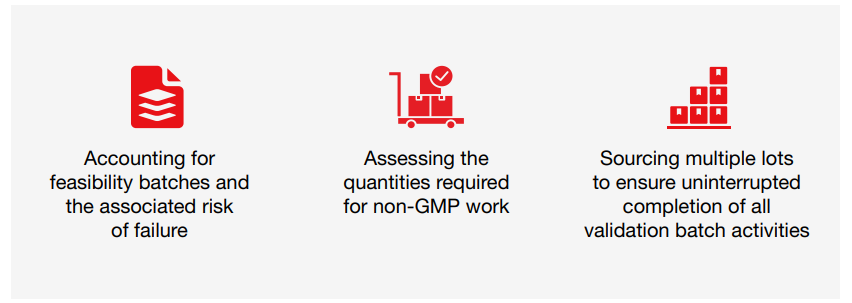
This approach is part of an effective supply chain strategy, which is critical in minimizing disruptions and delays. Effective planning is reinforced using a client performance dashboard, enabling real-time tracking and management of inventory levels, thus ensuring that supply needs are met promptly and efficiently. There is much more at stake from a monetary and time perspective to go back and figure out a way to get more APl/drug substance.
8. Understand CPPs (critical process parameters) and CQAs (critical quality attributes)
Outlining the critical process parameters and critical quality attributes of your process can help with knowledge transfers, consistency, and regulatory filing. As part of your operations, do these activities and outline scopes:
CPPs:
- Identify CPPs
- Conduct studies for ranges and hold times
- Develop IPCs (in-process controls)
- Create design space
CQA:
- Assay-related substance
- Dissolution
- Blend and content uniformity
- Physical parameters
- Particle size
Key considerations:
- Perform process studies where possible to understand parameters
- Repeat studies if changes are made to the scale or process
- Challenge the CPPs during the feasibility batches manufacturing to prepare for validation
If you don’t establish this early on, you will have a trial-and-error approach trying to outline everything and make it work; it’s imperative to determine your risk and align with your COMO on the approach.
9. Proactively address secondary and tertiary packaging needs
As you prepare for operational readiness, be proactive in addressing all packaging requirements before process performance qualification (PPQ). Utilize feasibility tests to assess everything from bottling and coding, to labeling and serialization, and plan for artwork and package inserts in advance. Running these activities in parallel and considering the steps holistically accelerates the timeline.
Leverage Thermo Fisher Scientific’s end-to-end expertise, honed over 260 technology transfers within our global network, to ensure every aspect of packaging is meticulously planned and executed. This preemptive approach prevents delays in commercial launch, leveraging our capability to manage comprehensive packaging needs seamlessly and efficiently.
Connect with us today to discuss your next tech transfer project.
Visit our web site to learn about our oral solid dose solution and know what’s ahead.
About Thermo Fisher Scientific:
From molecule to medicine: An integrated partner for every step in your drug development journey.
Thermo Fisher Scientific provides industry-leading pharma services and solutions for drug development, clinical trial logistics, and commercial manufacturing through our Patheon™ brand. Partnering with customers in the pharmaceutical, biotech, and life sciences industries as a trusted CDMO, Thermo Fisher Scientific enables its customers to deliver medicine to patients faster.
With more than 60 facilities around the world, Thermo Fisher Scientific provides end-to-end pharma services across all phases of development and commercial manufacturing, including API, oral solid dose, biologics, cell therapy, mRNA, viral vectors, formulation, clinical trial solutions, logistics services and packaging.
Thermo Fisher Scientific couples scientific and technical excellence in these areas with a strategic partnership, giving customers of all sizes access to a global network of facilities and dedicated experts across the Americas, Europe, Asia, and Australia. Through integrated service offerings, Thermo Fisher Scientific offers tailored solutions to fit your unique drug development journey, accelerating your time to market.
Discover the power of partnership and a global network.
