

Granulation is one of the most important unit operations in pharmaceutical solid dosage manufacturing. Despite already having been in use for many years, the choice of the correct technology can still cause issues in several situations.
For many operators, this subsequently means running at less than optimum performance – and particularly when it comes to scaling up, inaccuracies can creep in which subsequently become noticeable in production.
However, with a sensible concept, it is possible to not only reduce development time and costs but also develop a better product.
The right steps for a scale-up
Regardless of the particular process step, there is one golden rule that applies to scaling up. The ratio by which a plant is scaled up – whether for high shear granulation, a single pot process, or for fluidized bed granulation – should never exceed 1:10.
In terms of high shear granulators, machines with a capacity of 0.25l to 10l have proved a successful size for galenical development. This means that, if one has opted for a 6l vessel, a scale-up to 60l is possible for applications such as the production of clinical samples.
Scale-up tools for granulation systems
Many R&D departments still employ an empirical approach to scale-ups. One typical test is to see whether the product can be easily compacted in the hand and whether more liquid needs to be added. However, results of this type are highly personal and therefore cannot be validated.
DIOSNA not only has decades of experience in the production of granulating systems but also with scale-ups and the associated process validation. The company also offers portable appliance testing (PAT) software packages with advanced analytical tools for statistical data. This data can also be used for batch reports, data backup, or remote assistance.
In addition, an end-point determination is a valuable aid – although its importance is often underestimated. This defines both the mean value and the distribution of a target particle size.
Pitfalls of scaling up in practice
As a rule, two processes are regarded as being similar if there is a geometric, kinematic, and dynamic similarity between them. When it comes to geometric similarity, it is factors such as the ratio of the height and diameter of the vessel that counts.
Kinematic similarity looks at the ratio of speeds between two measurement points. Here, it is not the rotational speed that needs to be the same but the circumferential speed at the outer ends of the mixing tool (i.e. the tip speed). The dynamic similarity relates to the ratio of forces at two measurement points.
When describing dynamic processes, it is important that dimensionless parameters like the Froude number and the Reynolds number are considered. The Froude number has proved particularly useful for the scaling up of high shear mixers. To achieve comparable granulation results between the individual scale-up steps, the Froude number should always be kept constant.
However, there are many other parameters that need to be considered during the development of the model. For years, DIOSNA has created successful scale-up models that have been repeatedly tested and adapted with research and trials.
Pilot scale production in the pharmaceutical industry
Pilot-scale production is an indispensable intermediate step in pharmaceutical development, which occurs after the products have been developed in the R&D labs and before they are ready for commercial production in large volumes.
The following parameters need to be considered to enable a smooth scale-up:
- Similar geometry of mixing tools and mixing vessels
- Similar Froude numbers
- Similar filling ratios
- Similar liquid addition rate per kilogram of product
For instance, a pharmaceutical company wants to develop a product in 100kg batches. The product should initially be developed on the lab scale, on a 1kg batch size. During scale-up, the batches should be 10kg to facilitate the upscaled production size of 100kg.
What if the same company wants to manufacture another product in 250kg batches? changes can indicate differences between lab and pilot equipment as different bowl sizes are required to accommodate the increased batch size.
For clinical trials, pilot-scale equipment is used for small-scale production, which may require a lot of different batch sizes and products in a short period of time. This is where DIOSNA’s Rapid Change concept can help.
High-shear mixers in pilot-scale granulation
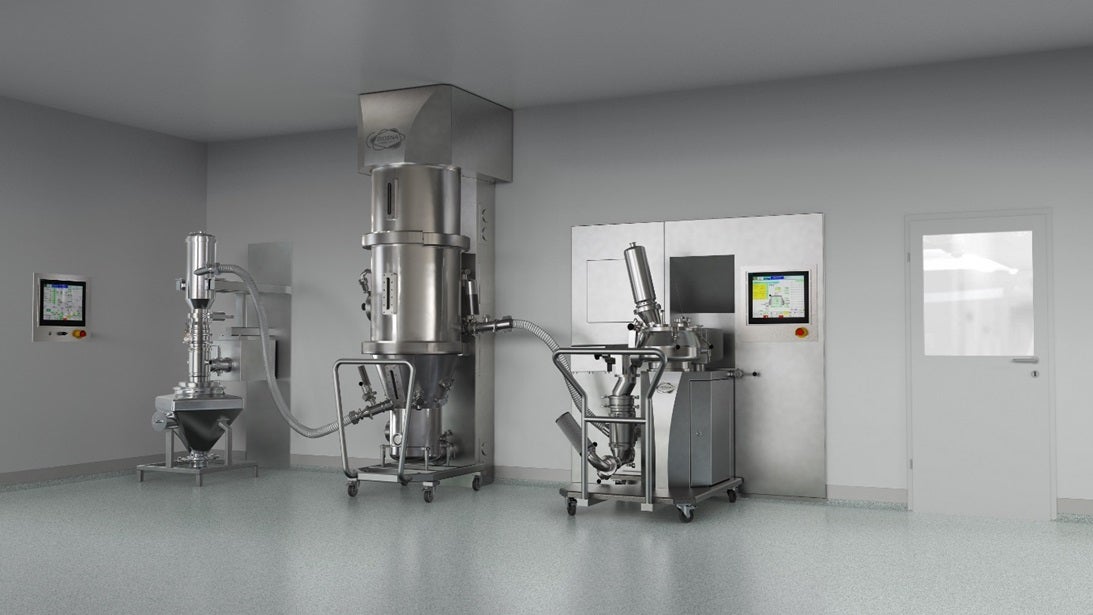
The P 10-80 RC is a high-shear mixer/granulator with four different bowl sizes. Its design provides each bowl size as a self-supported mobile module. The drives and control system are installed in a through-the-wall design while the process modules can be combined with the drive component in the technical area in just a couple of minutes without tools.
The CAP 10-80 RC is a fluid-bed processor with two different bowl sizes, so it can cover the same range as the P 10-80 RC. The bowls are moveable on wheels and can be connected simply and rapidly without tools. Due to its special filter concept with ergonomic access via a hinged expansion chamber, the processor has a low built-in height, so it fits under ceilings as low as 3,100mm without compromising the process capabilities of the CAP 10-80 RC.
The combination of the above-mentioned equipment results in the integrated, highly flexible CCS 10-80 RC granulation line. It also includes peripherals such as wet mill, dry mill, vacuum discharge unit and optionally a lifting column for the discharge unit and the dry mill. The control system of the granulation line is central, and all of its components are connected.
The advantages of DIONSA’s granulation solutions include:
- High flexibility
- Space-saving due to a compact design
- Hygienic, due to the through-the-wall design
- A wide batch range from 1.5kg to 35kg
- Quick and ergonomic changeover between modules
Conclusions and outlook
In product development, validated results from the galenical scale need to be translated to the production scale. Therefore, particularly suitable scale-up methods include flexible modular plants with interchangeable containers that can replicate a range of different processes such as mixing, drying and coating.
The ability to switch modules without additional tools, availability of robust touchscreens, options for containment or connection of an automatic loading or emptying system, air-conditioning, or operation with solvent all make it easier to make the transition from laboratory scale to pilot or production scale.
DIOSNA can assist you in these processes not only with the corresponding equipment and systems but also with training courses designed to ensure that a reliable and successful scale-up. Our experience has shown that a well-thought-out development process not only makes for a better product but also helps to improve understanding of the process overall, which in turn helps to save costs in production and time to market.
