


The ADC market
The first antibody drug conjugate (ADC) was approved in 2000 by pairing a cytotoxic chemotherapy agent with the targeting abilities of a monoclonal antibody, and the market has been on quite the journey since then. More than 20 years and many technical and safety challenges later, the field is still relatively early in its evolution yet is now recognized as one of the most promising and fastest-growing segments in oncology.
As of May 2026, there are approximately 23 ADC biopharmaceutical products approved globally and many more in late-stage clinical trials. According to GlobalData, 93 Phase III clinical trials were initiated for ADCs in 2025, compared to 67 in 2024 and 31 in 2023. Last year, the market was valued at around $20 billion and is expected to reach $60 billion by 2030. Statistics like these highlight the rapid expansion of ADCs, while a quick glance at the pipeline – revealing 412 different programs in various stages of clinical trials – illustrates the magnitude of the field.
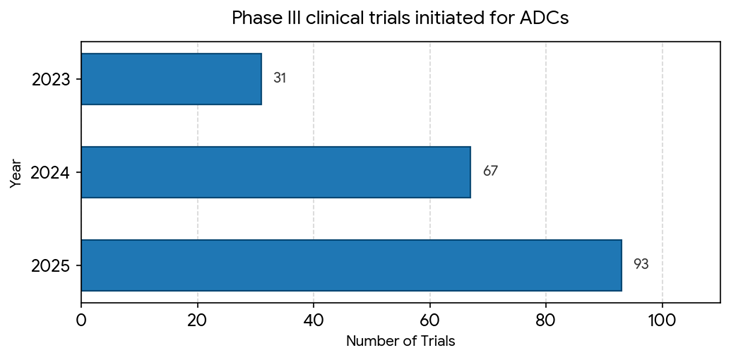
Source: GlobalData
This growth is not just about volume but diversification. New targets, novel payload strategies, and combination therapies are expanding the scope of ADCs well beyond their original applications. In research settings, the potential of ADCs is even being explored for non-oncology indications such as autoimmune diseases, viral infections, and neurological disorders. In oncology, meanwhile, the market is becoming more dynamic, with frequent new market approvals, label expansions, and evolving treatment paradigms. ADCs initially approved for advanced cancers are now being studied and adopted across broader tumor types and earlier stages of treatment, reflecting their expanding role in modern oncology care.
Secondary packaging challenges
ADCs require sophisticated packaging technologies, processes, and expertise to meet the dual requirements of both biologics and potent small-molecule payloads. As new ADCs are introduced to market, there has been a significant increase in the reliance on contract development and manufacturing organizations (CDMOs) and contract packaging organizations (CPOs), which have already invested in the specialized containment systems, enhanced operator safety protocols, and rigorous environmental controls needed to safely handle ADCs.
“Secondary packaging activities are a critical component of the product’s overall control strategy,” says Jeff Benedict, CCO, Sharp. “Packaging processes must ensure protection from contamination and degradation, provide accurate and compliant labeling, and facilitate safe handling of hazardous materials.”
On top of this, stability is a key concern for the biologically active component of the ADC, with secondary packaging and handling processes helping to protect the drug from temperature, humidity, and light. With any deviations risking significant implications for product and human safety, packaging must be robust and highly validated. Yet at the same time, the latest ADC trends emphasize the need for agility and scalability.
“Many ADCs are launched with relatively small, indication-specific patient populations and then expand over time as new indications are approved,” explains Benedict. “This demands a specialist ‘high mix-low volume’ packaging environment capable of supporting small batch production, frequent changeovers, and evolving label and configuration requirements — adding significant operational complexity.”
Agility is crucial in this environment, he emphasizes. Packaging operations must efficiently accommodate multiple SKUs while maintaining compliance. For pharmaceutical companies, partnering with a commercial packaging partner that can adapt to changing demand as the therapies expand across indications and global markets is critical to sustained success.
Future ADC packaging trends
Today, ADCs are often packaged as lyophilized powder in specialized sterile vials, with light-protective cartons designed to further protect the product during storage and shipping. As these therapies evolve, so will alternative delivery formats. From pre-filled syringes and ready-to-use presentations to future integration with autoinjector and pen platforms, these developments have the potential to improve convenience for patients while also reducing burden on healthcare providers. Commercial packaging teams play a critical role in enabling this transition by aligning with the pharma companies’ drug-device combination strategies and ensuring functional and packaging compatibility is retained across the lifecycle of the delivery formats.
With the role of the CDMO continuing to evolve, companies like Sharp are already supporting these phased lifecycle approaches. “Sharp serves as a strategic packaging partner integrated across the ADC product lifecycle,” notes Benedict. “Our secondary packaging teams engage early in development to help biopharma companies efficiently prepare for scale-up, commercialization, launch readiness, and ongoing lifecycle management.”
In addition, the sustainability of the packaging solution has become a key area of collaboration between a CDMO and its pharma client. Packaging partners create value by helping balance sustainability goals with the structural, containment, and regulatory requirements unique to ADCs. Because these therapies require high-containment handling and robust product protection, improving the overall carbon footprint of the packaging depends less on reducing materials and more on targeted design optimization and operational efficiency of the packaging process.
In structural packaging design, efforts focus on rightsizing and eliminating non-essential components, while selectively introducing lower-impact or recyclable materials where they meet performance standards. Meaningful gains can also be realized in cold chain and logistics through reduced shipping weight, improved pack configurations, and less insulation waste.
The greatest impact, however, comes from operational efficiency upgrades at high-containment packaging facilities. These production environments are inherently energy-intensive, therefore efficient HVAC systems and real-time digital monitoring must be prioritized to reduce energy consumption while maintaining compliance and safety.
Overall, the highly potent, dual-natured chemistry of ADCs requires unique, robust, safe, and compliant packaging systems and high-potent handling controls, while the relatively small batch sizes and global SKU complexity can challenge commercial GMP efficiency.
As the ADC market begins to ramp up and become increasingly competitive, sponsors also need to consider new market launches for the US, EU, and the rest of the world. They will require packaging partners that can handle the dual complexity of delivering rapid, multi-country launches while also scaling from small batch sizes to large-scale volumes.
Sharp has the breadth of secondary injectable packaging services and depth of expertise that ADC manufacturers require to successfully launch their therapies safely. Besides supporting cartoning, kitting, and serialization, the company specializes in cold chain storage and handling processes for sensitive, highly potent products.
Sharp also offers packaging design services to help companies meet the complex needs of ADCs, which require robust secondary packaging to protect against potential vibrations, drops, and impacts that could happen during transport. Sharp operates US Foreign-Trade Zones (FTZs) and also provides EU QP release to market, enabling batch certification and market release to be managed in parallel with packaging activities.
With an expanding network to support global markets and more than 70 years of experience supporting pharmaceutical launches, the team is well positioned to help ADC manufacturers get their drugs to market efficiently and securely, adding value, expertise, and agility at every step of the way.
For more information, download the paper below.
