
TNFSF Trimers: From Biology to Therapeutic Innovation
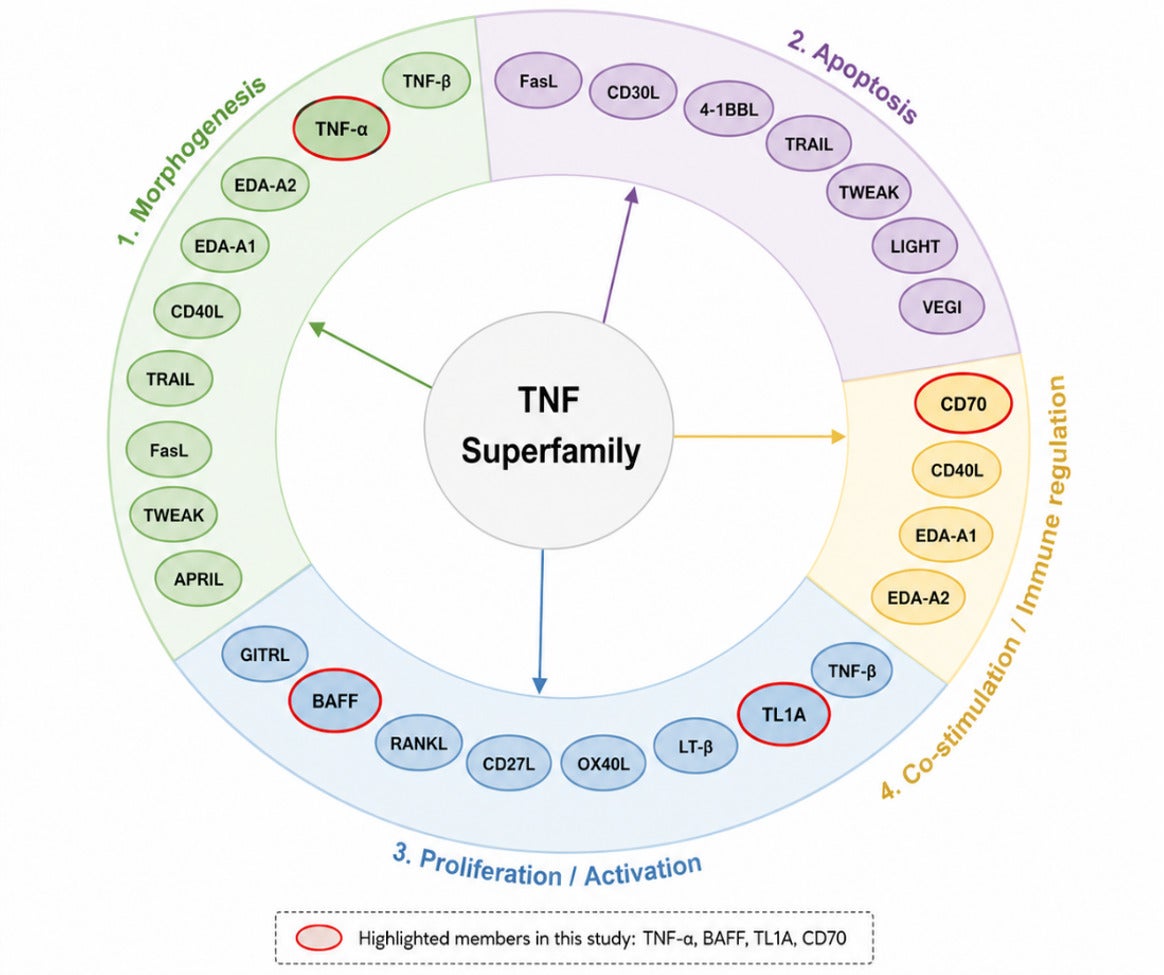
TNF superfamily (TNFSF) proteins are key regulators of immune homeostasis and inflammation. Many TNFSF proteins naturally assemble as homotrimers, a structural feature that is critical for receptor binding and downstream signaling. Members such as TNF-α, BAFF, TL1A, RANKL and CD70 play critical roles in immune activation, B-cell function, inflammatory signaling, and tumor immunity. Their central roles in these pathways have made them attractive targets for the development of novel biologics, immunotherapies, and next-generation therapeutic modalities. Sino Biological offers high-quality, native-like TNFSF trimer proteins to support therapeutic target research and drug discovery.

Translational and clinical validation of TNFSF targeting
The clinical success of TNFSF-targeted therapies highlights the importance of accurately modeling TNFSF biology during target validation, antibody discovery, and therapeutic development. Landmark therapies targeting TNF-α and RANKL have demonstrated the therapeutic value of TNFSF family members across chronic inflammatory diseases, bone disorders, and immune-mediated conditions, establishing TNFSF proteins as a clinically validated target class.
More recently, BAFF-, TL1A-, and CD70-directed therapeutics have further expanded the clinical impact of TNFSF-targeted interventions in autoimmune diseases and cancer. BAFF-targeted therapies have demonstrated efficacy in systemic lupus erythematosus, while TL1A- and CD70-directed therapeutics have gained significant attention as promising approaches for inflammatory bowel disease and cancer. Together, these advances underscore the growing translational and therapeutic significance of TNFSF-targeted drug development.
Table 1. Representative TNFSF-targeted therapeutics and clinical development programs.
| TNFSF Member | Major Indications | Representative Therapeutic Programs | Development Status |
|---|---|---|---|
| TNF-α (TNFSF2) | Rheumatoid arthritis, psoriasis, IBD | Humira®, Remicade®, Enbrel® | Approved |
| BAFF (TNFSF13B) | Systemic lupus erythematosus | Benlysta® | Approved |
| APRIL (TNFSF13) | Multiple myeloma, autoimmune diseases | Atacicept | Late-stage clinical |
| CD40L (TNFSF5) | Autoimmune diseases, transplantation | Dapirolizumab pegol | Phase III |
| CD70 (TNFSF7) | Hematologic malignancies, solid tumors | ADCs, TCEs, CAR-T therapies | Clinical development |
| 4-1BBL (TNFSF9) | Cancer immunotherapy | 4-1BB agonist programs | Clinical development |
| OX40L (TNFSF4) | Autoimmune diseases, cancer | OX40/OX40L-targeted antibodies | Clinical development |
| TRAIL (TNFSF10) | Solid tumors, hematologic malignancies | TRAIL receptor agonists | Clinical development |
| RANKL (TNFSF11) | Osteoporosis, bone metastasis | Prolia® (denosumab), Xgeva® | Approved |
| TL1A (TNFSF15) | Inflammatory bowel disease | MK-7240, RVT-3101 | Phase III |
Research applications of native-like TNFSF trimer proteins
Native-like trimeric TNFSF proteins enable biologically relevant receptor engagement and downstream signaling. For example, recombinant human TNF-α protein (Cat# 10602-HNAE) and cynomolgus/rhesus TNF-α protein (Cat# 90018-CNAE) were used by Dave et al. to characterize antibody–antigen complex formation in a DLS assay (Figure 2). In another study, recombinant human RANKL protein (Cat# 11682-HNCH) was used to induce osteoclast differentiation from human PBMCs in the presence of M-CSF, supporting bone remodeling and osteoporosis research.
Sino biological native-like TNFSF trimer proteins
Sino Biological provides a comprehensive portfolio of high-quality, native-like TNFSF trimer proteins to accelerate therapeutic target research and drug discovery. By preserving the native trimeric structure required for efficient receptor activation and downstream signaling, these recombinant proteins enable biologically relevant experimental models for antibody discovery, functional characterization, and translational research. Each product is rigorously validated for purity and biological activity using orthogonal analytical and functional assays, ensuring high quality, batch-to-batch consistency, and reproducible experimental results.
Table 2. validated native-like TNFSF trimer proteins
| Molecule | Cat# | Species | Purity verified | Activity validated |
|---|---|---|---|---|
| TL1A (TNFSF15) | 17049-H07H2 | Human | SDS-PAGE, SEC-MALS | SPR |
| TL1A (TNFSF15) | 5A7685-M07H1-UE | Mouse | SDS-PAGE, SEC-MALS | SPR |
| BAFF (TNFSF13B) | 10056-HNCH | Human | SDS-PAGE, SEC-HPLC | Cell-based assay |
| BAFF (TNFSF13B) | 10056-H42H-B | Human | SDS-PAGE, SEC-MALS | ELISA |
| APRIL (TNFSF13) | 10610-H07H2 | Human | SDS-PAGE, SEC-MALS | SPR |
| APRIL (TNFSF13) | 91072-C01H | Human | SDS-PAGE, SEC-MALS | SPR |
| CD70 (TNFSF7) | 10780-H07H5 | Human | SDS-PAGE, SEC-HPLC | ELISA |
| CD70 (TNFSF7) | 51129-M07H2 | Mouse | SDS-PAGE, SEC-HPLC | ELISA |
| RANKL (TNFSF11) | 11682-HNCH | Human | SDS-PAGE, SEC-MALS | Cell-based assay |
| OX40L (TNFSF4) | 13127-H07H | Human | SDS-PAGE, SEC-MALS | ELISA |
| OX40L (TNFSF4) | 13127-H07H-B | Human | SDS-PAGE, SEC-MALS | ELISA |