


Bringing a new drug to market is one of the most time‑consuming and costly assignments within the pharma industry. From early research to launch, drug development typically takes 12 to 18 years, at an average cost of around US$2.6 billion[i]. Only about 10% of drug candidates make it through clinical development[ii].

In recent years, AI and machine learning have emerged as credible ways to address these pressures. Through predictive modelling, AI can align resources on the most promising formulations and improve the likelihood that selected candidates will progress successfully through development.
But with modern drug candidates growing increasingly complex, this can be especially challenging. Many small molecules emerging from discovery are highly lipophilic, poorly water-soluble, and exhibit low permeability, which directly impacts bioavailability and clinical success.
At the same time, development teams are expected to make critical decisions early – often with limited API, incomplete data, and compressed timelines. Traditional empirical approaches, while still essential, can lead to iterative cycles that consume time and API material without guaranteeing success. As a result, the core challenge today is not just solving solubility or formulation issues, but doing so earlier, faster, and with greater confidence, while minimising risk and resources.
Where is AI having the greatest impact?
According to GlobalData’s Drugs database, there are just over 4,100 drugs that have been developed or repurposed using AI[iii]. The majority sit in discovery or preclinical stages, with far fewer in late-stage clinical development or marketed status.
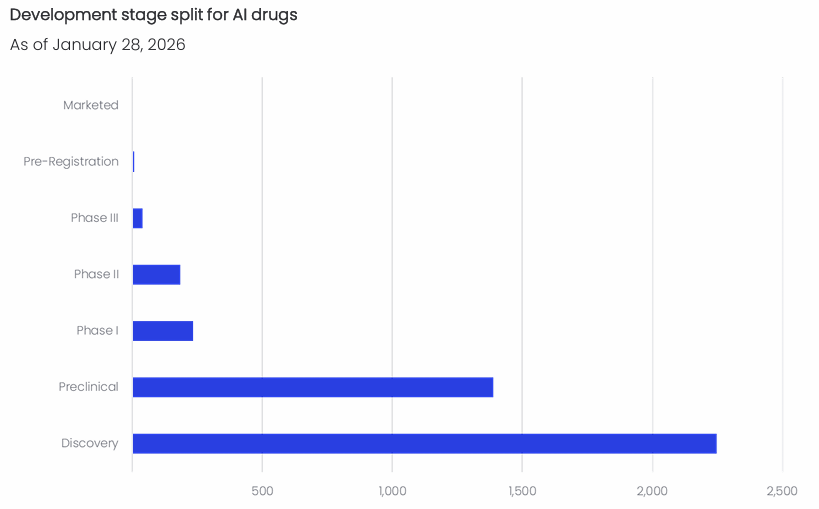
It is these early stages of drug discovery and development where uncertainty is highest, and decisions have the greatest downstream impact. Here, AI supports target identification, prediction of physicochemical properties such as solubility and permeability, and formulation strategy selection.
It is no surprise then that AI adoption is strongest in oncology, CNS disorders, immunology, and infectious diseases, where molecular complexity is high and traditional approaches often fall short. With early-stage decisions defining the trajectory of a programme, AI enables teams to narrow the experimental space and avoid costly late-stage failures.
By helping researchers to focus on the most viable candidates early in the drug development process, AI has the potential to reduce costs and accelerate timelines. But its greatest potential lies in its ability to make drug discovery more efficient and cost-effective; an acceleration that could have a measurable impact on a company’s drug development economics.
What does this mean for drug developers?
Crucially, AI is demonstrating its ability to shorten the time from target identification to candidate nomination by rapidly generating hit compounds, improving target-disease linkage accuracy, and selecting better patient populations for trials. While AI is particularly strong at analysing large datasets to uncover new biological targets in early discovery, it is also helping with protein structure prediction, optimising molecular interactions, and even scaling up production to ensure compounds are commercially viable.
For development teams, this equates to several key benefits:
Speed: Prioritising high-probability formulations and reducing iterations.
Reduced risk: Improving confidence in formulation decisions and reducing late-stage failures.
Cost-efficiencies: Reducing API consumption and unnecessary experimentation, as well as freeing up cash flow for companies to pursue innovative therapies and increase the number of new drugs approved.
AI could further diversify drug development by enabling smaller companies to design high-quality molecules without vast lab infrastructure. It could also unlock progress in rare diseases, neglected indications, or emerging pathogens, where traditional business models can struggle to justify investment.
Navigating regulatory risk
In short, AI enables pharmaceutical and biotechnology companies to gain a more efficient, predictable, and data‑driven development pathway, with lower experimental burden and cost, faster identification of viable formulations, and reduced risk of late‑stage failure.
Sanjay Konagurthu, PhD., Senior Director, Science and Innovation at Thermo Fisher Scientific, shares an example of these benefits in action: “In one programme involving a poorly soluble compound, predictive modelling identified suitable polymer systems and formulation strategies early. This led to the development of a spray-dried dispersion formulation with significant bioavailability improvement, including approximately an eight-fold increase in Cmax and a five-fold increase in AUC compared to the crystalline form. This enabled rapid progression into clinical trials while minimising development risk.”
Ensuring that AI-generated recommendations are rigorously validated and transparently documented is critical, says Konagurthu, so that development teams, QPs, and regulators are fully comfortable relying on them.
“AI-generated predictions are confirmed through targeted experimental studies to ensure alignment with real-world performance,” he says. “Models are built on transparent methodologies, supported by physicochemical data, and integrated with PBPK and other modelling outputs to provide a comprehensive evidence package for regulatory confidence.”
This evidence package approach works in compliance with joint guidance drafted by US and European regulators in January 2026[iv]. Released by the European Medicines Agency (EMA) and the US Food and Drug Administration, the guidance advises industry members on how best to incorporate AI into their workflows, recommending ten key principles to help “lay the foundation for developing good practice” when using the technology in long-term growth plans.
It suggests that drug developers maintain detailed and traceable records of the data sources used to train their AI models, as well as the steps taken to process that data, to help them stay in line with Good Practice (GxP) requirements and ensure standards are upheld over the long term.
Other guidelines include validating and accounting for risks when using AI, while ensuring that regular risk-based performance assessments investigate the complete system, using metrics and data relevant to the context in which it is used. To help companies align with tightening ethical, legal, scientific, regulatory and cybersecurity standards, the draft guidance also recommends that models are high-quality, human-centric, and compliant by design.
Predictive modelling
For the organisations that successfully deploy a compliance-led AI strategy to drug development pathways, the rewards can be significant. But those that are set to lead are applying AI beyond asset discovery, using it not only to identify promising candidates but to systematically de‑risk the development pathways that determine whether those candidates ever reach patients.
Thermo Fisher Scientific is a leading end-to-end CDMO providing integrated drug substance, formulation, and commercial manufacturing services for small and large molecule medicines worldwide, pioneering in this space by integrating predictive modelling with real-world development and manufacturing expertise.
“Thermo Fisher Scientific’s AI-enabled approach, through platforms such as OSDPredict™ and Quadrant 2®, integrates molecular data, physicochemical properties, and target product profiles to guide formulation strategy for small molecules from the outset,” explains Konagurthu.
“In practice, this means screening formulation technologies in silico, predicting drug–excipient compatibility, and prioritising high-probability experimental candidates. These predictions are then validated through targeted experimentation, creating a closed-loop workflow that combines computational insight with empirical confirmation.”
AI is embedded within a broader, model-informed development workflow that combines AI/ML, physics-based modelling, process considerations, and experimental validation. This ensures predictions are actionable and scalable, translating complex molecular behaviour into clear formulation decisions aligned with manufacturing and regulatory expectations.
According to Konagurthu: “The model has demonstrated a 90% success rate in identifying solubility enhancement technologies and 80% accuracy in excipient selection. This means fewer reformulation cycles, lower API consumption and shorter timelines. Rather than experimentally screening many formulation approaches, teams can concentrate on a small number of high‑probability options, cutting unnecessary lab work and delays and allowing development programmes to progress with greater confidence and efficiency.”
The next five years
AI-enabled, model‑informed development is beginning to close the gap between discovery ambitions and development realities. Predictive modelling offers a practical way to focus scarce material, shorten iteration cycles, and bring greater confidence to formulation decisions.
Thermo Fisher’s experience shows that when AI is tightly integrated with physicochemical understanding, process knowledge, and targeted experimental work, it can reliably guide technology selection, excipient choice, and programme design. Konagurthu expects that over the next three to five years, the use of AI will expand to influence broader development decisions.
“AI is evolving beyond early-stage screening to influence dosage form selection, process design, manufacturability, scale-up, and clinical trial design,” he says. “As tools integrate more data, they will enable a holistic, model-informed development paradigm across the entire lifecycle.”
For Thermo Fisher, the next phase focuses on greater integration, scalability, and real-time decision support, including expanding predictive capabilities across modalities, enhancing integration between formulation and process modelling, and leveraging larger datasets to improve accuracy. The goal? A fully connected development ecosystem that accelerates the delivery of therapies to patients.
[i] GlobalData: Artificial Intelligence in Healthcare, September 2024
[ii] GlobalData: Artificial Intelligence in Healthcare, September 2024
[iii] GlobalData: Looking Ahead to 2026 the Future of Pharma, April 2026
[iv] FDA: Considerations for the Use of Artificial Intelligence To Support Regulatory Decision-Making for Drug and Biological Products, January 2025
