

Much larger than traditional small molecule drugs, peptides enable rapid tissue penetration while retaining the selectivity and potency of a larger molecule. However, major challenges include poor oral bioavailability and rapid degradation, resulting in short durations of action and frequent redosing, typically via injection.
Much of today’s innovation is centred on overcoming these challenges, and significant progress has already been made. According to GlobalData’s database, there are currently more than 2,000 peptides in the drug development pipeline, including 624 in discovery and 1,069 in preclinical. In 2025, peptides made combined global sales of $91.38bn according to GlobalData, with the top six sellers all examples of GLP-1 receptor agonists.
Peptide purification challenges
For biotechs developing novel peptides, CRO/CDMOs offer invaluable support, helping companies overcome preclinical challenges in synthesis, purification, stability, and delivery. Synthesis obstacles can be particularly tricky, as Orocidin discovered during the development of its lead molecule QR-01, a 37-amino acid, cationic, amphipathic peptide for aggressive periodontitis.
Orocidin needed to achieve a target purity greater than 99% to progress the compound into clinical trials. However, the peptide’s rich content of hydrophobic and basic amino acids made it prone to aggregation during solid-phase peptide synthesis (SPPS), leading to incomplete coupling and low yields. The peptide was also highly sensitive to oxidation and poorly soluble, creating further purification challenges.
To overcome the obstacles, Syngene’s team created a customised synthesis and purification process using a low-loading resin that helped to prevent sequence-induced aggregation during SPPS. An optimised cleavage cocktail helped to avoid side reactions common with arginine-rich peptides, resulting in a crude peptide with a purity greater than 50%. From there, Syngene developed a single-step reverse-phase HPLC purification method using a tailored gradient to resolve co-eluting impurities. This final step achieved a peptide purity over 99%, with a single maximum impurity of just 1% and total impurities of 0.6%.
According to news reports, Orocidin is now commencing a toxicity programme for QR-01, another significant step towards clinical development.
GLP-1s: Why now?
The first GLP-1 receptor agonist, the twice daily injection exenatide, was approved for use in 2005 thanks to its ability to promote insulin release in response to food intake. Since then, the industry has followed with increasingly longer-acting versions. As significant weight loss effects were observed, Wegovy (semaglutide) and Mounjaro (tirzepatide), which help patients lose up to 20% of their body weight in 17 months, were specifically approved for weight management. From there, demand skyrocketed.
Today, GLP-1 activity shows no signs of slowing down. 2026 will see the debut of oral GLP-1 options such as Lilly’s orforglipron, while new competitors such as Amgen and Pfizer get ready to enter the scene. Patent expiries for semaglutide are right around the corner in Asia, and generics and biosimilars are already in development. Moreover, GLP-1 receptors have now been found in the heart, lungs, and kidneys, meaning therapeutic possibilities continue to expand.
GLP-1 biosimilars: A semaglutide case study
In the last two years, the number of new Phase I peptide trials has jumped from 18 in 2023 to 72 in 2024 and 137 in 2025 – a 661% increase. While much of this is innovation, bioequivalence studies also play a part as generic and biosimilar development ramps up.
Bioequivalence studies are essential for ensuring that new generics/biosimilars are therapeutically equivalent to their brand-name counterparts. However, challenges often include regulatory misalignments, high pharmacokinetic variability, study design flaws, and analytical difficulties.
When planning bioequivalence studies, companies frequently partner with CRO/CDMOs to accelerate time-to-market. In one example, a global pharma company outsourced a lengthy bioequivalence study for semaglutide to Syngene. During this process, Syngene solved a range of analytical challenges, from quantifying the therapeutic peptides via immunoassay platforms to managing the sensitivity of LLOQ measurements and overcoming column/system block, deficient chromatography, and autosampler carryover problems.
Significant clinical challenges were also faced, with participants experiencing severe gastrointestinal side effects and a drastic loss of appetite, partially owing to a high initial dose. To help participants through this difficult time and minimise attrition, Syngene provided medical counselling alongside appropriate treatments and personalised nutritional advice. In general, regular communication was essential for ensuring participant safety, with accommodation provided near Syngene’s clinical unit to always ensure prompt access to care.
Supporting peptide programmes from end to end
A true end-to-end CDMO partner for peptide therapeutics, Syngene supports peptide development and manufacturing from discovery through GMP manufacturing. In the early stages, the company places a strong emphasis on developing scalable, manufacturable processes, from SPPS and hybrid synthetic strategies that minimise resin loading, cycle times, and solvent burden, to process optimisation frameworks and ‘developability’ assessments such as solubility screening, forced degradation studies, stability profiling, and impurity mapping.
As programmes advance from discovery to the clinic with increased confidence, Syngene’s dedicated GMP SPPS suites, kilo-lab and pilot-scale purification systems, controlled handling environments, and high-capacity lyophilisation suites provide the perfect infrastructure for scaling up peptide programmes. Supported by Syngene’s highly experienced team, audit-ready quality systems, full CMC documentation packages, and end-to-end QC/QA oversight, peptide sponsors can access a unified pathway for accelerating their therapeutics with quality and reliability.
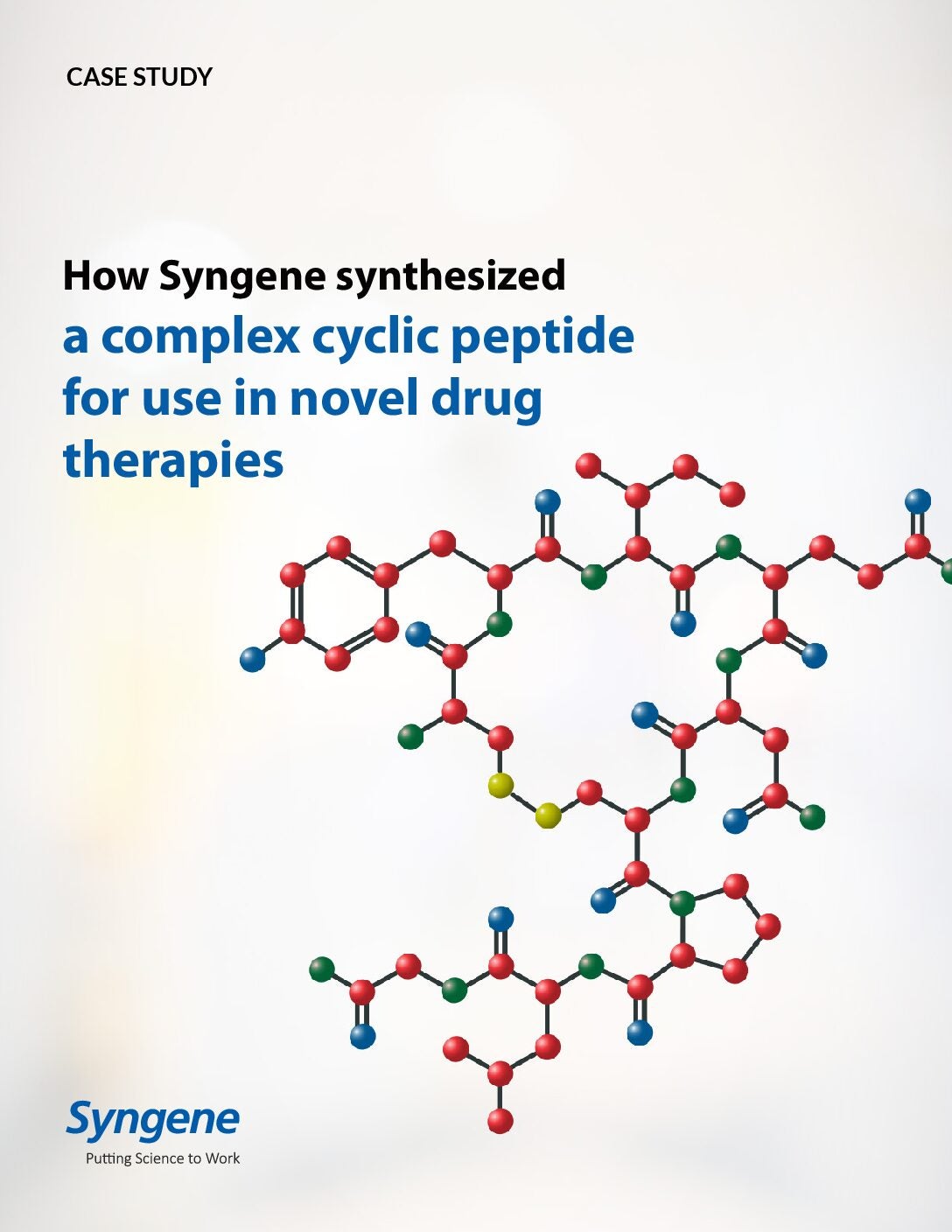
To learn more, check out the case study below.
