

FUNDALOOP® SU Single-Use Filter
Why cell harvest is a bottleneck in single-use processing
Harvest and clarification are often the least flexible steps in a single-use process. Depth filters foul as cell density rises, so higher titers and larger batches mean more filter area, more flushing and more plastic waste. Centrifuges can handle the solids load, but they bring cleaning, validation and a large footprint back into an otherwise disposable facility.

How FUNDALOOP® SU multi-cycle filtration works
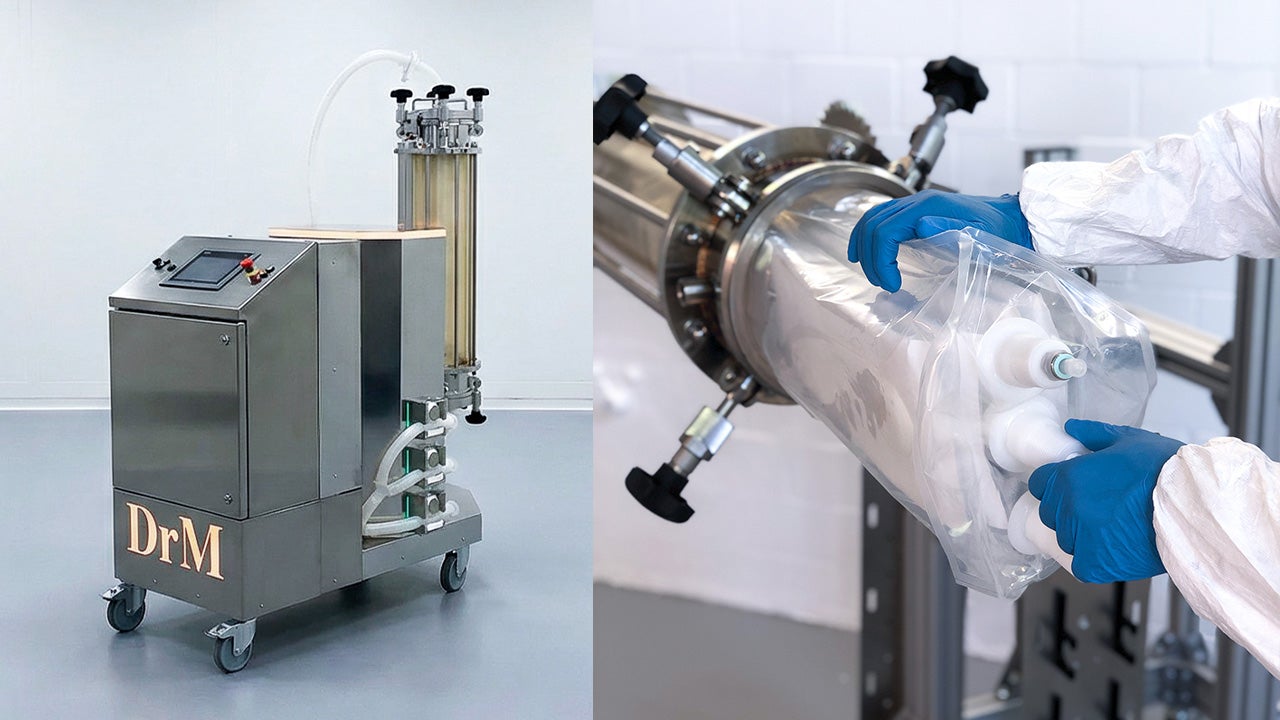
FUNDALOOP® SU applies cake filtration inside a single-use bag placed in an outer pressure vessel. Each cycle runs through four steps:
- Filtration: Cells and debris, combined with a filter aid such as diatomaceous earth, build a porous cake on the filter elements while the clarified liquid passes through.
- Heel volume filtration: Gas pressure between the vessel and the bag squeezes the remaining liquid through the cake, so residual product is recovered. An optional cake wash can follow.
- Back-flush: Sterile buffer or WFI is pushed back through the elements, releasing the cake and regenerating the thin filter cloth.
- Discharge: The solids leave through the bottom valve, and the filter is ready for the next cycle.
What multi-cycle operation changes for process engineers
Because the filter regenerates after every cycle, its area no longer has to be sized for the full solids load of the batch. A larger batch or a denser culture simply means more cycles on the same hardware, which gives a linear, predictable scale-up path. There is no preflush, and the smaller filter area means less product contact, lower extractables and leachables, and less plastic waste. Operation is fully automated with 21 CFR Part 11 compliant software, and three skid sizes cover batches of up to 100l, 400l and 5,000l.
Performance in CHO cell harvest
In CHO harvest applications, the regenerating filter cake keeps flow rates stable where depth filters tend to clog, and product yields of up to 98% can be reached after cake washing. Adding an ion exchange resin to the feed lowers DNA and host cell protein levels close to those of a two-stage filter train, in a single clarification step. Flow rates and filtrate quality remain consistent from lab to production scale and over repeated cycles. In a typical 2,000l CHO harvest, primary clarification can be achieved with less than 1 m² of filter area, a fraction of what alluvial or depth filtration would require at the same scale.
Typical applications in biopharmaceutical manufacturing
FUNDALOOP® SU is used for cell recovery or cell removal in batch, fed-batch and perfusion processes, including:
- CHO, HEK293, Vero and Sf9 cultures for recombinant proteins and monoclonal antibodies
- viral vector production
- microbial fermentation, such as lysed E. coli for plasmid DNA recovery
Test FUNDALOOP® SU with your own process fluid
Results depend on the product and process, so DrM offers lab and pilot FUNDALOOP® units for rent or purchase. Trials with your own culture define flow rates, filtrate clarity, yield and cycle parameters before you commit to a full-scale system.
To discuss your harvest or clarification step with DrM’s engineers, send an enquiry through the DrM company profile page.