
ProPure™ Endotoxin-Free Proteins: Minimising Invisible Risks in Cancer and Immunology Research
Endotoxin, a lipopolysaccharide (LPS) originating from the outer membrane of Gram-negative bacteria, remains one of the most prevalent and challenging contaminants in recombinant protein preparations—particularly those derived from E. coli expression systems or prokaryotic plasmids. Even at trace levels, endotoxin can trigger potent systemic and neuroinflammatory responses, significantly altering cellular behaviour and confounding experimental outcomes.

Endotoxin presents a unique challenge: it is highly heat-stable and resistant to conventional removal strategies, necessitating rigorous control throughout both upstream production and downstream purification processes.
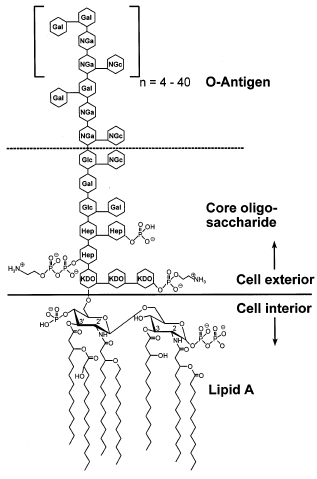
Fig. 1. Schematic view of the chemical structure of endotoxin from E. coli O111:B4 according to Ohno and Morrison (1989). Hep, L-glycero-D-manno-heptose; Gal, galactose; Glc, glucose; KDO, 2-keto-3-deoxyoctonic acid; NGa, N-acetyl-galactosamine; NGc, N-acetyl-glucosamine.
What is Endotoxin (LPS)?
Endotoxin, or LPS, is composed of three major structural components (Fig. 1). The outermost region, known as the O-antigen, consists of repeating oligosaccharide units that are highly variable and strain-specific, thereby determining the serological identity of the bacterium. Beneath the O-antigen lies the core oligosaccharide, a comparatively conserved structure. Anchoring the molecule is Lipid A, the most conserved and biologically active component of endotoxin.
This hydrophobic domain adopts a highly ordered, hexagonal arrangement, contributing to its structural rigidity and exceptional stability—properties that also make endotoxin particularly difficult to remove during protein purification processes.
Prevalence of endotoxin contamination
In biotechnological production processes, it is essential to identify the source of endotoxin contamination—whether it originates intrinsically from the production system or is introduced through non-sterile conditions (Fig. 2). Requirements may vary significantly depending on whether the product is used for diagnostic or therapeutic purposes.
However, for therapeutics administered at high doses, such as serum albumin or monoclonal antibodies, even minimal endotoxin contamination becomes unacceptable due to the large total exposure. In these cases, highly effective strategies are required to remove residual endotoxin traces that persist after conventional purification processes.
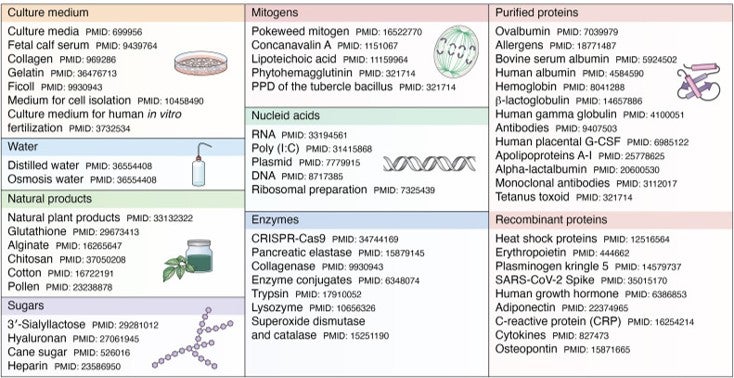
Fig. 2. Endotoxin contamination is diverse and ubiquitous. List of publications with PubMed identifiers dealing with recognised endotoxin contamination of various products that can be encountered during biological experiments.
Endotoxin is also ubiquitous in the environment, with human exposure occurring through agricultural and industrial activities, textiles, and even everyday settings such as homes and offices—primarily via contact with dust. This diversity and pervasiveness make controlling endotoxin contamination a critical consideration at all stages of protein production.
Endotoxin risks in experiments and assays
Even trace levels of endotoxin can silently disrupt experiments, especially in antibody generation. By altering the host immune response, endotoxin contamination can reduce antibody quality, specificity, and consistency, ultimately compromising the reliability of results.
For sensitive applications, endotoxin control isn’t optional—it’s critical for:
- Animal immunisation for high-quality antibody production
- Preclinical toxicology & PK studies with minimal immune interference
- In vitro cell assays (proliferation & differentiation) free from false signals
- Accurate cytokine detection for reliable immunological insights
How Sino Biological controls endotoxin to the ProPure™ level
While pharmacopeial guidelines such as USP <85> provide general limits for endotoxin, cutting-edge immunology and translational oncology studies often require far stricter control. Sino Biological’s ProPure™ endotoxin-free recombinant proteins are designed to eliminate this variable at the source, supporting reliable results from early discovery through IND-enabling studies.
Produced at the state-of-the-art Center for Bioprocessing (C4B) in Texas, ProPure™ reagents are rigorously controlled to achieve levels as low as 0.05 EU/mg, with select products reaching an exceptional 0.01 EU/mg—over ten times lower than typical industry standards (Table. 1).
Table 1. Sino Biological ProPure™ partial product list with endotoxin level leading the industry standards.
| Molecule | Cat# | Species | Purity | Endotoxin Level | Activity |
| EGFR | 10001-H08H-UE | Human | SEC-MALS verified | <0.01 EU/mg | ELISA, BLI |
| Her2/ERBB2 | 10004-H08H-UE | Human | SEC-MALS verified | <0.05 EU/mg | ELISA, BLI |
| VEGFR2/KDR | 10012-H08H-UE | Human | SEC-MALS verified | 0.03 EU/mg | Cell activity |
| 4-1BB/CD137 | 10041-H08H-UE | Human | SEC-MALS verified | 0.01 EU/mg | ELISA |
| PD-L1/B7-H1 | 10084-H08H-UE | Human | SEC-MALS verified | 0.005 EU/mg | ELISA, BLI |
| M-CSFR/CSF1R | 10161-H08H-UE | Human | SEC-MALS verified | <0.05 EU/mg | ELISA |
| CD25/IL-2R alpha | 10165-H08H-UE | Human | SEC-MALS verified | 0.01 EU/mg | Cell activity, BLI |
| HER3/ERBB3 | 10201-H08H-UE | Human | SEC-MALS verified | 0.09 EU/mg | ELISA |
| AXL | 10279-H08H-UE | Human | SEC-MALS verified | <0.05 EU/mg | ELISA, SPR |
| IL-13 | 10369-H01H-UE | Human | SEC-MALS verified | 0.1 EU/mg | ELISA |
| PD-1 | 10377-H08H-UE | Human | SEC-MALS verified | <0.01 EU/mg | ELISA, BLI |
| CD16a/FCGR3A | 10389-H08H-UE | Human | SEC-MALS verified | <0.1 EU/mg | SPR, BLI |
For more information, please visit this page.