


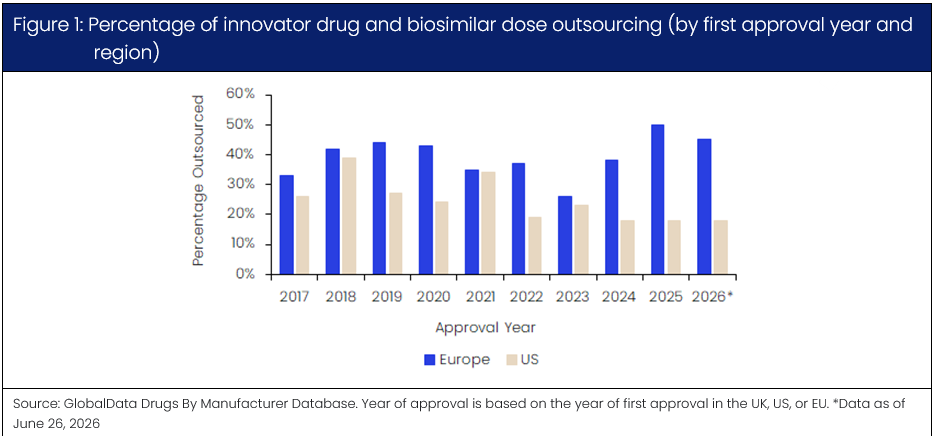
In 2025, the dose outsourcing gap between the proportion of newly approved biosimilar and innovator products outsourced to European and US facilities was the widest yet, with Europe taking a substantial lead. The first half of 2026 is continuing that trend.
Contract manufacturing facilities located in the US and Europe provide biopharma companies with strategic options to diversify supply chains, access specialised technologies, and speed time-to-market for new drugs. Outsourced dose manufacturing for innovator drugs and biosimilars approved in the US and Europe (EU and UK) has traditionally oscillated between the two geographies, but there has been a pronounced shift toward European facilities over the last two years.
Go deeper with GlobalData

According to GlobalData’s Drug By Manufacturer Database, the most recent full-year figures show a widening of the gap between use of European and US facilities, with the first half of 2026 continuing that trend. In 2025, 50% of new drugs had dose manufacturing contracts with European-based facilities, almost doubling their share since 2023. By contrast, that proportion for US-based facilities has remained a static 18% since 2024, leading to a substantial widening of the outsourcing gap between the two geographies. Despite fluctuations over the last decade, including instances of US-based facilities coming close to European outsourcing proportions in 2018, 2021, and 2023, Europe has continuously held its lead.
National tax systems are one element supporting that growth. Irish facilities accounted for 13% of the region’s dose manufacturing contracts in 2025, up from approximately 6% in 2024. Ireland increased its Research and Development (R&D) Corporation tax Credit to 35% in January 2026, building on an earlier increase in 2024 from 25% to 30%. It is now one of the most competitive rates in Europe. Germany, which contributed just over a fifth of European dose outsourcing for new drugs in 2025, also offers a generous R&D tax credit of 25–35%. By contrast, the US offers companies an Alternative Simplified Credit of between 6% and 14% (depending on increases in R&A spending).
Policies such as R&D tax credits are one lever for countries to encourage CDMOs to develop manufacturing techniques and technologies, and support the expansion of specialised facilities on European soil. Biosimilars, in particular, tend to require scalable commercial manufacturing and specialised production technology. Celltrion Inc., which specializes in generic and biosimilar drug development, outsourced nine dose manufacturing contracts to European facilities in 2025, up from seven in 2024, reflecting its reliance on specialised European manufacturing partners.
Although dose outsourcing of newly approved drugs to the US and Europe has fluctuated over the past decade, the gap between the two regions was at its the widest in 2025, and 2026 looks set to extend that picture of biopharma’s strategic preference for European outsourcing facilities.

