
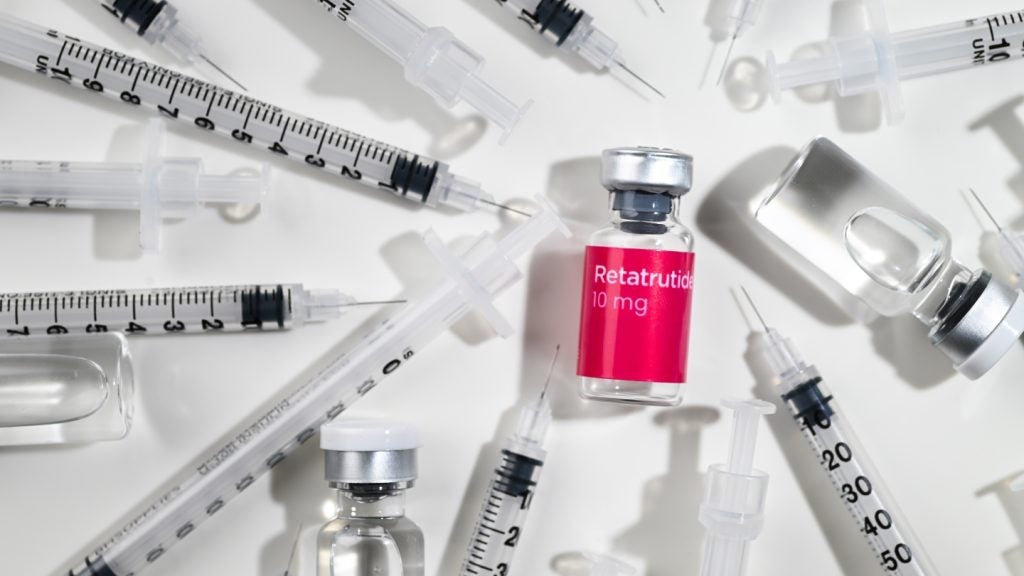
On 21 May 21, 2026, Eli Lilly’s retatrutide achieved a historic first; as of June 2026, it is the only drug to produce an average weight loss above 30% in a clinical trial.
The drug’s significant efficacy has led to experts positing: how much weight loss is enough? Doctors prescribing glucagon-like peptide-1 receptor agonist (GLP-1RA)-based therapies, and biotechs developing the next wave of drugs, say 30% is likely enough for most patients.
According to a GlobalData report, the already massive weight loss drug development sector is still expanding and shows no sign of stopping. GLP-1RA use among non-diabetic users increased 700% from 2019 to 2023, reaching over 174,000 patients. GlobalData, the parent company of Pharmaceutical Technology, now forecasts related sales will increase at a 17% compound annual growth rate (CAGR) from 2024 to 2031 to become worth more than $182bn.
Eli Lilly’s retatrutide is one of the frontrunners in the next wave of such drugs, as it simultaneously targets GLP-1, glucagon, and glucose-dependent insulinotropic polypeptide (GIP). Data from the Phase III TRIUMPH-1 trial reported that retatrutide-treated obese patients lost an average of 28.3% of their body weight after 80 weeks compared to just 2.2% with placebo. This increased to 30.3% after 104 weeks, and the patients who switched to retatrutide from the placebo arm then saw 19.2% mean weight loss.
The frenzied competition between rival developers in the weight loss space has so far focused simply on maximising the amount of weight patients can lose with their drugs. Now that retatrutide has met this high weight loss benchmark, which some experts consider to be sufficient and as safe as can be handled for most patients, they are looking for new improvements to GLP-1RAs through other avenues.
Improving safety, preserving lean muscle mass, and better addressing obesity’s many comorbidities are the routes by which experts speculate developers will seek to grab and hold market share.
The race for weight loss is won
Retatrutide’s 30% weight loss marks it as the most competitive drug in development, says endocrinologist Dr. Sanjay Kalra from Bharti Hospital in Karnal, India, who predicts it will supplant Eli Lilly’s leading Zepbound (tirzepatide) in the next five years. However, in most cases, a weight loss closer to 20% is satisfactory, notes Dr Anurag Mehta, assistant professor of cardiology at Emory University in Atlanta, Georgia.
Moreover, even a 20% weight loss can sometimes be too much, says Dr Timothy Garvey, professor of medicine at the University of Alabama in Birmingham and an investigator for the REDEFINE-1 obesity trial. The REDEFINE-1 trial was a study of Novo Nordisk’s semaglutide/cagrilintide combination CagriSema, targeting GLP-1 and amylin receptors. The combination showed 20.4% weight loss in patients where treatment effect was measured regardless of adherence. “We had to decrease the dose on several patients. They were just losing too much weight,” he says.
The race for incremental improvements on weight loss is over, Ariel Feldstein, CSO of internal medicine at Pfizer told this news service at the 2026 BIO International Convention in San Diego. Now, a deeper understanding of the nature of weight loss is needed while innovation should be explored elsewhere, he says.
Innovation lies in the margins
With a ceiling of practical weight loss met by retatrutide, small differences matter less, Dr Rob Myers, chief medical officer at the metabolic disorders-focused biotech OrsoBio, said at the 2026 BIO International Convention. Myers says the secondary factors that obesity agents can offer now matter more.
GLP-1RAs have been dogged throughout development by side effects, particularly those that are gastrointestinal. In TRIUMPH-1, adverse events (AE) led to 11.3% of patients at the highest dose of the drug dropping out, compared to 4.9% with placebo. Garvey notes that the key unmet need in obesity right now is tolerability, even if it means deprioritising efficacy.
Similarly, the loss of lean mass has proven a persistent issue for the class. This is especially important among older patients, who are more prone to both obesity and muscle loss as they age, notes Dr. Naim Alkhouri, hepatologist at NorthShore Gastroenterology in Westlake, Ohio.
Taken together, the next frontier of innovation is to maintain patients on these medicines for longer, according to Feldstein. He says exploring different modalities, like antibody-drug conjugates (ADC) or small interfering RNAs (siRNAs), to improve tolerability, targeting, and crucially to lower dose frequency is the key opportunity for differentiation.
Differentiating means treating comorbidities
A handful of GLP-1RAs are on the market for obesity, led by Lilly’s Zepbound and Novo Nordisk’s Wegovy (semaglutide) since their launches in 2021. But the exponential profits those drugs have brought in recent years are driving a frenzy of competing development. The Zepbound and Wegovy brands generated sales of $13.5bn and $11bn in 2025, respectively, as per GlobalData’s report.
If retatrutide has found the upper limit of practical weight loss, these molecules need other ways to stand out. Approvals for obesity’s subpopulations are key to greater market share, says Shelby Tungate-Lopez, PharmD, assistant professor of pharmacotherapy at the University of North Carolina in Chapel Hill.
Tungate-Lopez notes that even weight loss as low as 5% can impact the heart, kidneys, and other organs. In fact, Alkhouri says there is evidence that GLP-1RAs have therapeutic effects independent to weight loss, potentially addressing liver disease, although only semaglutide currently has an approval to treat metabolic dysfunction-associated steatohepatitis (MASH).
As they are associated with multiple comorbidities, obesity treatment plans are often plagued by polypharmacy. Alkhouri says obese patients who often have hypertension, diabetes, sleep apnea, and others may need as many as 10–12 different daily medications. “This is the excitement around the GLP-1RAs and the dual and triple agonists, that you can treat multiple comorbidities with one medication,” he says.
A new commercial reality
Lilly’s retatrutide data attracted significant investor interest, supporting broad confidence in the company’s stock despite concerns over the drug’s tolerability. However, Garvey says investors tend to place more importance on exact weight loss percentages than the doctors working with these drugs.
Furthermore, the way patients approach GLP-1RAs is changing, according to Tungate-Lopez. He says that greater access to information, such as using artificial intelligence (AI), means that “people are coming into the clinic, and it’s almost like fast food; they’re ordering exactly what they want.”
However, as with most new drugs, price is often a deciding factor. Many patients will seek the most potent therapies, but they will also often be compelled to accept more affordable options, Tungate-Lopez says. He adds that as more drugs enter the market, the pricing competition becomes fiercer for out-of-pocket spending and, conversely, increases the number of drugs covered by insurers.
With the expected onslaught of newer drugs designed to effectively treat obesity, how doctors and patients will choose which drugs to use is unclear. The answer, Garvey says, lies in the fact that obesity is a heterogeneous condition. Each patient has their own profile of disease severity, causes, and associated comorbidities. Importantly, each patient may respond differently to different GLP-1RA options. “The more tools we have—arrows in the quiver, if you will—the better we can individualise care,” Garvey says.
Tungate-Lopez says there are many instances in which a doctor could deliberately prescribe a GLP-1RA that is less efficacious than possible, depending on the patient being treated. For example, he worries that patients who are struggling with nutrition at baseline could suffer malnutrition if appetite suppression and weight loss are induced too heavily.
He also notes that older patients may require gentler weight loss so as not to exacerbate age-related muscle loss. The less potent GLP-1RAs can therefore still prove to be valuable additions to the therapeutic toolbox.