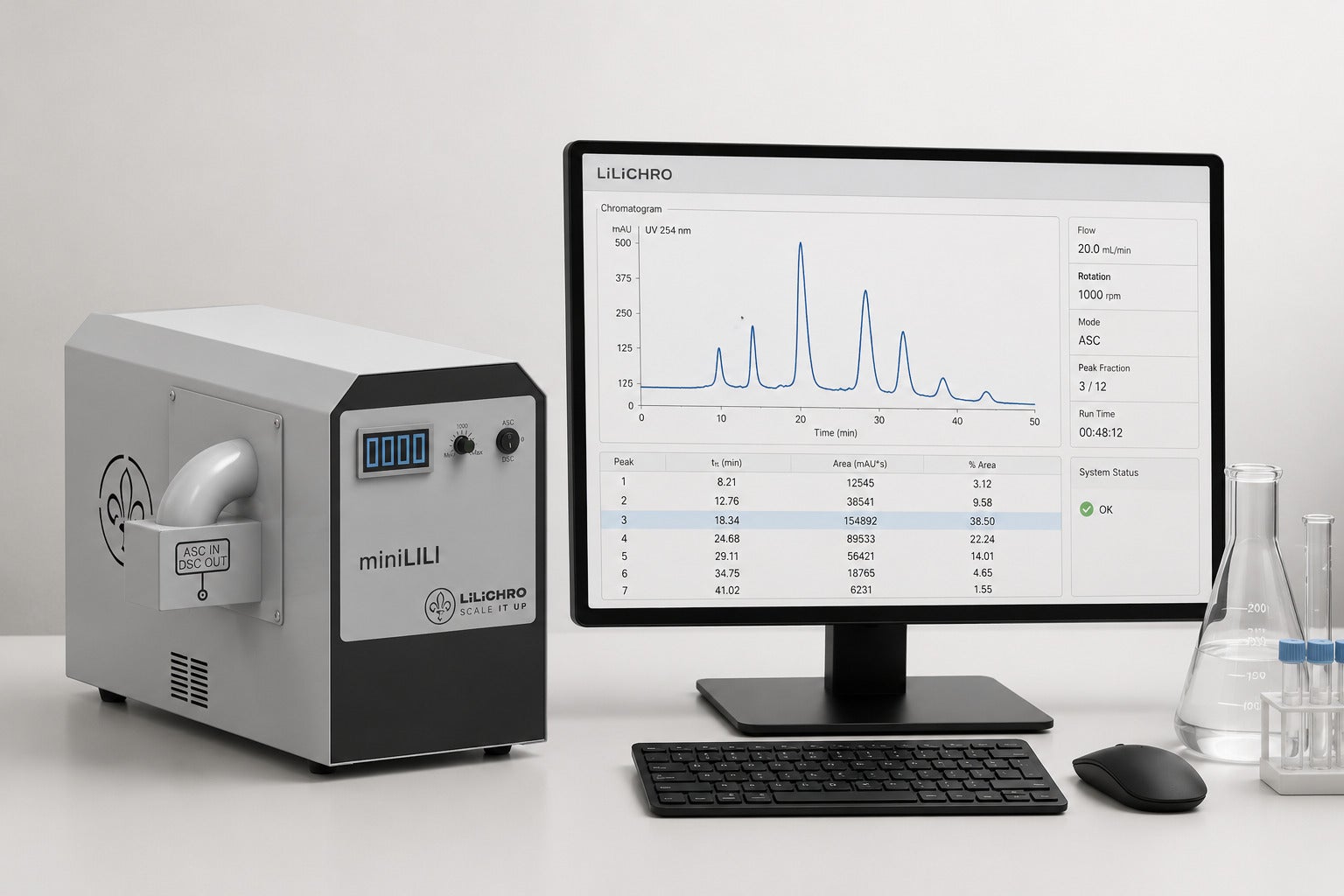
Centrifugal partition chromatography, or CPC, is a preparative chromatographic technique based on liquid-liquid partitioning. It does not use silica, C18, resin, or any other packed solid stationary phase. Instead, CPC uses two immiscible liquid phases.
One liquid phase is retained inside a rotating rotor. The other liquid phase is pumped through it. As the sample moves through the system, each compound repeatedly distributes between the two liquids. Compounds that prefer the mobile phase move faster. Compounds that spend more time in the retained liquid phase move more slowly.
This is the key technical point behind CPC. It is chromatography, but not the kind most HPLC users first imagine. The stationary phase is not a solid. It is a liquid.
That is also why László Frici Németh and the LiLiChro team often explain CPC through the language of liquid-liquid chromatography. “Centrifugal partition chromatography” is scientifically correct, but it can hide the most important idea: the separation happens between two liquid phases.